
AR

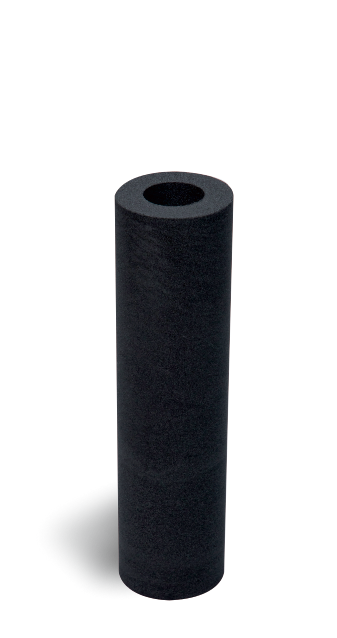
Celrith's sintered activated carbon rod filter (Ф32×106 mm) is a water purification filter element made from high-iodine coconut shell activated carbon and food-grade ion exchange resin, sintered into a rigid porous block. It removes residual chlorine, odours, colour, and harmful heavy metals such as lead and mercury from drinking water, while the ion exchange resin softens the water and helps prevent scale buildup. This filter is designed for household reverse osmosis (RO) systems, refrigerators with built-in water dispensers, direct drinking machines, and commercial coffee machines. Celrith manufactures it in Zhongshan, Guangdong, China, with flexible sizing and OEM/ODM support.
Municipal water often carries residual chlorine from disinfection, which reacts with organic matter to form taste and odour compounds. Even at low concentrations, these substances affect the taste of drinking water and can degrade the performance of downstream filters and appliances. In addition, water hardness leads to scale on heating elements and membranes, while trace heavy metals such as lead and mercury may be present in older distribution systems. For coffee machines and refrigerators, these contaminants directly affect beverage quality and equipment reliability. The challenge is to remove them without introducing new particles or restricting flow.
Celrith's sintered carbon rod addresses this by combining adsorption and ion exchange in a single, uniform structure. The coconut shell carbon provides a high surface area for adsorbing chlorine, odours, and organic compounds, while the ion exchange resin captures hardness minerals and some heavy metals. The sintering process creates a rigid block with controlled porosity, so the filter does not shed carbon fines (black powder) into the water, unlike loose granular carbon. This means cleaner water and less risk of clogging downstream components.
When water carries particles, chlorine, or hardness, the load transfers to the equipment: RO membranes foul faster, heating elements scale, and valves and seals wear. In coffee machines, scale and chlorine degrade flavour and shorten the life of boilers and pumps. Refrigerator water dispensers may develop odours and biofilm if chlorine is not controlled. The cost of this load appears as more frequent maintenance, higher energy consumption, and reduced water quality. By placing an effective carbon block upstream, the contaminant load is intercepted before it reaches sensitive components.
Celrith's filter is designed to handle this load with a high adsorption capacity and a microporous structure that maintains flow. The initial pressure drop is low, and the filter retains its integrity throughout its service life. Because it does not release fines, it also protects downstream membranes and valves from particulate contamination. This is particularly important in RO systems, where even small amounts of carbon dust can damage the membrane. The ion exchange resin further reduces the scaling potential, which is beneficial for appliances that heat water.
Celrith manufactures the sintered carbon rod using a 100% flexible moulding process that allows customisation of outer diameter from Ф30 to Ф60 mm and any length. The standard size shown here, Ф32×106 mm, is one of several common dimensions; others include Ф60×130, Ф62×240, Ф37.5×75, Ф38×57, Ф40×195, Ф51×127, and Ф32×126 mm. The filter can be produced with custom end caps and welding to fit specific housings. The carbon block is made from selected coconut shell carbon with a high iodine number, ensuring strong adsorption of chlorine and odours. Food-grade ion exchange resin is incorporated to soften water and reduce heavy metal content. The sintering process bonds the carbon particles without adding binders that could leach, and the result is a filter with uniform micro-pores, high initial flow, and high filtration accuracy. It does not release black powder, and its high saturation capacity contributes to a long service life. Typical filtration accuracy is 5 micrometres, and the expected life is 6 to 12 months depending on feed water quality and usage.
| Item | Detail |
|---|---|
| Product name | Carbon Block Water Filter / CTO Filter for water purifiers and refrigerators |
| Core filtration materials | High-iodine coconut shell activated carbon + food-grade ion exchange resin |
| Core performance | Softens water and prevents scaling; strongly adsorbs residual chlorine (bleaching powder); removes off-colour and odour; intercepts harmful heavy metals such as lead and mercury |
| Accuracy and filter life | Uniform micro-pore structure, high initial flow, high filtration accuracy, no black powder release; large adsorption saturation capacity, long service life |
| Standard size references (outer diameter × length, mm) | Ф60×130 / Ф62×240 / Ф37.5×75 / Ф38×57 / Ф40×195 / Ф51×127 / Ф32×126 / Ф32×106 |
| Main end applications | Household reverse osmosis (RO) pre-filter CTO / post-filter T33, direct drinking machines, side-by-side refrigerators with built-in water filters, commercial coffee machines |
| Customisation service | Full OEM/ODM support. Any length, diameter, or inner/outer diameter ratio can be tooled to match equipment needs; end cap welding customisation available |
| Quality certification system | Company's 20,000 m² production base is ISO 9001 and IATF 16949 certified. Filter materials meet strict drinking water safety and hygiene standards, backed by a national CNAS testing centre for quality control |
This carbon rod filter is used by manufacturers and assemblers of household water purifiers, particularly RO systems where it serves as a pre-filter (CTO) or post-filter (T33). It is also specified for direct drinking machines, side-by-side refrigerators with built-in water dispensers, and commercial coffee machines where water quality affects taste and equipment life. Because Celrith offers flexible sizing and OEM/ODM services, the filter is suitable for both standard and custom appliance platforms. Typical users include appliance brands, water treatment system integrators, and coffee equipment suppliers who require consistent filtration performance and reliable supply.
Celrith operates a 50,000 m² manufacturing plant in Zhongshan, Guangdong, China, which includes six cleanrooms totalling 20,000 m². The company holds ISO 9001, ISO 14001, and ISO 45001 certifications, and in 2024 added IATF 16949 certification for automotive quality management. Products comply with REACH and RoHS environmental regulations, and compliance documents can be provided. The on-site laboratory is CNAS-accredited and can issue test reports for filtration efficiency, dust holding capacity, and resistance, among other parameters. With over 20 years of experience in filtration R&D and manufacturing, Celrith has developed more than 1,000 filtration solutions and exports to Europe, the United States, Japan, and South Korea. Quality control follows IQC, IPQC, and OQC processes across multiple automated production lines.
To receive a quotation or discuss a custom specification, please contact our team and provide the following details: the device or vehicle model (if applicable), the required size or a drawing, the airflow or water flow rate, the operating conditions (such as temperature and pressure), and the estimated quantity. This information helps us recommend the most suitable configuration and provide an accurate quote. You can reach us through our contact page. We look forward to supporting your filtration requirements.
It removes residual chlorine (bleaching powder), off-colours and odours, organic compounds, and harmful heavy metals such as lead and mercury. The built-in food-grade ion exchange resin also softens the water and helps prevent scale. It is designed for drinking water applications in purifiers, refrigerators, and coffee machines.
The filter has a typical filtration accuracy of 5 micrometres and a high adsorption capacity. Under normal operating conditions, the expected service life is 6 to 12 months, depending on feed water quality and daily water consumption. The sintered structure ensures no black powder release, maintaining performance throughout its life.
Yes. Celrith offers full OEM/ODM customisation, including outer diameter from Ф30 to Ф60 mm and any length. End cap welding and specific inner/outer diameter ratios can be tailored to your device. Our engineering team can develop tooling based on your drawings or samples.
Samples are available for evaluation. Please contact us via our <a href="/en/contact">contact page</a> with your required specifications and quantity so we can arrange samples and provide a quotation. We will confirm sample availability and any associated costs based on your request.
The MOQ for standard sizes is typically 1,000 to 2,000 pieces, while custom sizes may require 5,000 pieces. Lead time for standard items is 7 to 15 days; custom orders generally take 25 to 35 days after approval. These figures may vary with order specifics, so please confirm with our sales team.
Replace the filter every 6 to 12 months, or sooner if you notice a decline in water flow or taste. The actual interval depends on the influent water quality and usage volume. Regular replacement ensures consistent removal of chlorine, odours, and heavy metals.
The production base is ISO 9001 and IATF 16949 certified, and the company holds ISO 14001 and ISO 45001 certifications. Products comply with REACH and RoHS, and the on-site CNAS-accredited laboratory provides test reports for filtration performance. These credentials support reliable quality and regulatory compliance.
Yes, it is commonly used in side-by-side refrigerators with built-in water filters and in commercial coffee machines as a pre-filter. The ion exchange resin reduces scale, which helps protect heating elements, and the carbon removes chlorine and odours that affect taste. Custom sizes are available to fit specific appliance models.