
AR

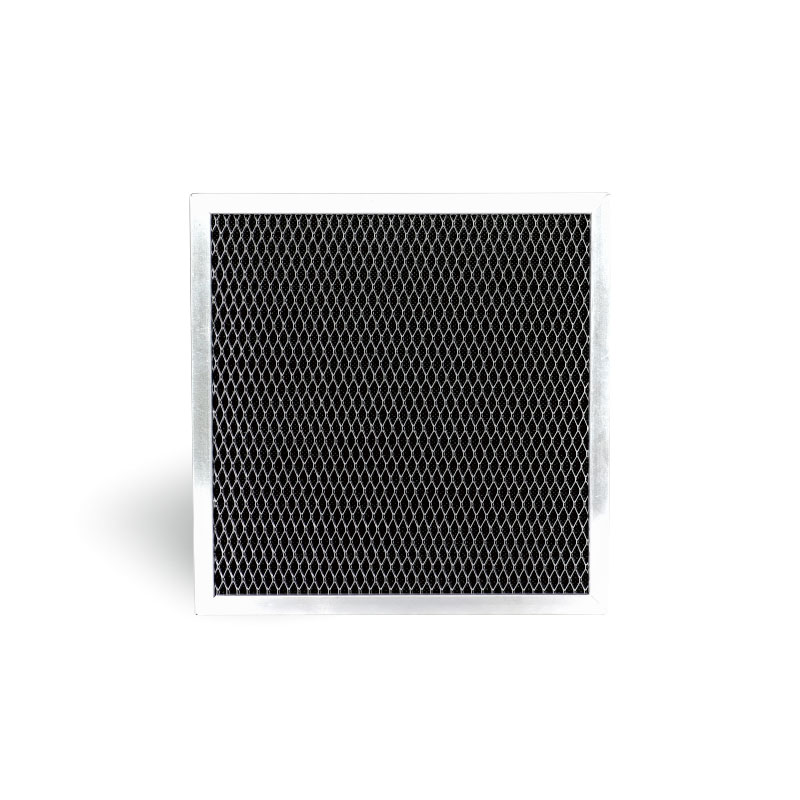
The Celrith American range hood filter is a multilayer aluminum filter with an integrated activated carbon layer, designed to capture heavy cooking grease and adsorb odours in recirculating and ducted range hoods. It filters oil mist, grease particles and cooking fumes, and is intended for kitchen exhaust systems in homes and commercial food service. Celrith manufactures this filter with a flame-retardant construction and offers full OEM customisation.
Cooking generates two distinct loads: grease and odour. Grease leaves the pan as an aerosol of fine droplets that coagulate into sticky films on cooler surfaces. Odour is a mixture of volatile organic compounds and gases that pass through ordinary mesh filters. In recirculating range hoods, both remain in the kitchen air unless the filter removes them.
Left unchecked, grease builds up on cabinet surfaces, walls and the hood interior, creating a fire risk and an unpleasant environment. Odours linger and spread to adjacent rooms. The Celrith filter addresses both problems through a composite structure: a labyrinth of corrugated aluminum foil for grease and an activated carbon layer for odours.
A clogged or ineffective filter increases the load on the entire ventilation system. The blower motor must work harder to move air through a restricted path, which raises energy consumption and shortens motor life. Grease that bypasses the filter deposits on fan blades and duct walls, reducing airflow and creating a flammable residue. In ducted systems, this can lead to costly cleaning and maintenance.
Odour control is equally important. Without adequate adsorption, cooking smells are recirculated into the living space. This is particularly problematic in apartments and commercial kitchens where exhaust options are limited. The Celrith filter's activated carbon layer is designed to capture these odorous gases before they are released back into the room.
The filter combines three functional layers. The outer layers of corrugated aluminum foil create a three-dimensional maze that traps grease particles through impaction and coalescence. The foil is resistant to high temperatures and corrosion, and can be cleaned for repeated use. Between the aluminum layers, a flame-retardant polyester fiber layer provides additional particulate filtration and support for the activated carbon.
The activated carbon layer is made from high-iodine-value carbon, which offers a large surface area for adsorbing odour molecules. This makes the filter effective for recirculating range hoods where odour removal is essential. The entire filter meets UL 900 Class 1 or Class 2 flame-retardant safety standards, reducing fire risk associated with grease accumulation.
Celrith manufactures the filter with a sturdy aluminum frame. Depending on customer requirements, different handle styles and plastic or metal clips can be selected to match the installation slot. Every dimension – length, width, thickness and number of aluminum foil layers – can be customised through flexible OEM/ODM production. This ensures a precise fit for specific range hood models.
| Item | Detail |
|---|---|
| Product name | American Range Hood Filter – Activated Carbon Composite (Celrith) |
| Core structure materials | Multilayer corrugated aluminum foil + flame-retardant polyester fiber + high-efficiency activated carbon layer |
| Core filtration function | Physical interception of heavy grease and protection of motor and fan wheel; strong adsorption of cooking odours |
| Fire safety rating | Complies with UL 900 Class 1 / Class 2 flame-retardant safety test standards |
| Main application terminals | American-style range hoods, ductless recirculating range hoods, kitchen exhaust fan systems, commercial kitchen grease removal equipment |
| Frame and clip customisation | High-strength aluminum frame; various handle styles and plastic/metal clips available to match customer installation slots |
| Size and specification customisation | 100% custom tooling based on customer equipment dimensions; length, width, thickness and number of aluminum foil layers can be flexibly produced via OEM/ODM |
| Quality certification system | Produced in the company's 50,000 m² plant with a CNAS-accredited laboratory; certified to ISO 9001/14001 and IATF 16949 automotive quality system |
The Celrith filter is used in American-style range hoods, ductless recirculating range hoods, kitchen exhaust fan systems and commercial kitchen grease removal equipment. It is suitable for households, restaurants, hotels and other food service operations that need effective grease and odour control. The customisable design also makes it a fit for appliance manufacturers and distributors looking for a reliable filter component.
Celrith products comply with REACH and RoHS environmental regulations, and compliance documents are available upon request. The company holds ISO 9001, ISO 14001 and ISO 45001 certifications, and obtained IATF 16949 automotive quality management system certification in 2024. The manufacturing base covers 50,000 m², including 20,000 m² of cleanrooms across six workshops. A CNAS-accredited laboratory provides test reports on filtration efficiency, dust holding capacity and resistance. With over 20 years of experience, Celrith has exported to Europe, the US, Japan and South Korea, and supports OEM/ODM projects with more than 1,000 filtration solutions developed.
To receive a quote or discuss a custom filter for your range hood, please provide the following details: your device or vehicle model, the required size or a drawing, the airflow or water flow (if applicable), the operating conditions, and the quantity needed. Our team will respond promptly with a tailored solution. Contact us to start the conversation.
It captures heavy cooking grease and oil mist through a multilayer aluminum foil maze, and adsorbs odours and volatile organic compounds with a high-iodine-value activated carbon layer. This dual action makes it effective for both ducted and recirculating range hoods.
The multilayer aluminum foil structure is designed to intercept heavy grease particles effectively, protecting the motor and fan wheel. For specific efficiency data, Celrith can provide test reports from its CNAS-accredited laboratory upon request.
Yes, the Celrith filter complies with UL 900 Class 1 or Class 2 flame-retardant safety standards, which helps reduce fire risk associated with grease accumulation. The aluminum and flame-retardant polyester construction is suitable for high-temperature cooking environments.
Absolutely. Celrith offers full OEM/ODM customisation, including dimensions (length, width, thickness), number of aluminum foil layers, frame style, handle type and clip design. Provide your device model or a drawing, and our engineering team will develop a sample typically within 2–3 weeks for confirmation.
For standard specifications, the MOQ is usually 1,000–2,000 pieces; custom specifications are negotiable. Lead time is 25–35 days for standard orders and 35–50 days for custom orders, depending on tooling development. With a monthly capacity of millions of pieces, Celrith can support large-volume supply.
Yes, Celrith welcomes sample requests. Standard samples are free, with the customer covering international courier costs. Custom samples may incur a tooling fee, which is typically refundable upon bulk order. CNAS test reports can also be provided to assist with product validation.
The aluminum foil layers can be cleaned periodically to remove accumulated grease, while the activated carbon layer will gradually lose adsorption capacity and should be replaced when odour control diminishes. Replacement frequency depends on cooking intensity; for heavy use, we recommend inspection every 2–3 months. Celrith can advise on a maintenance schedule based on your operating conditions.
The filter is produced in a facility certified to ISO 9001, ISO 14001, ISO 45001 and IATF 16949 (since 2024). Materials comply with REACH and RoHS regulations, and compliance documents are available. The CNAS-accredited laboratory supports performance testing and reporting.