
AR

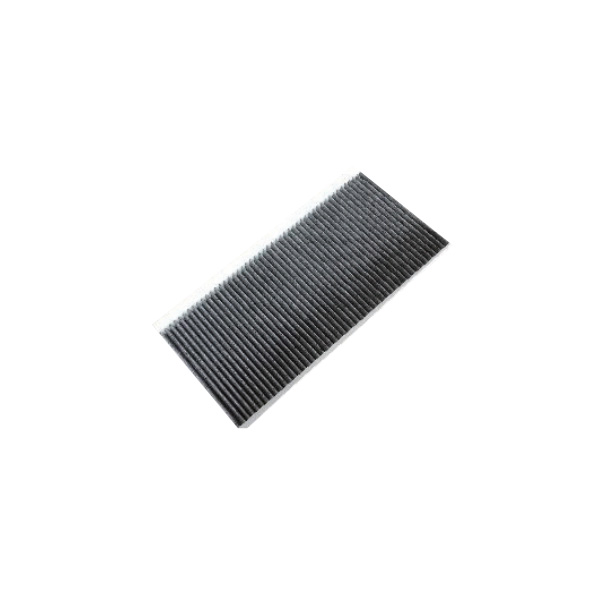
The Celrith automotive cabin air filter is a two-stage cabin filter that combines high-efficiency particle filtration with coconut-shell activated carbon to remove PM2.5 dust and odour-causing gases from the air entering the vehicle cabin. It targets fine particulate matter, ammonia, sulphides and exhaust VOCs, and is made for passenger cars, coaches, heavy trucks and construction machinery. Celrith supplies it as a standard replacement part or as a fully customised OEM/ODM filter built to a vehicle's air duct dimensions.
Air entering a vehicle cabin passes through a small filter housing, and everything the outside air carries arrives with it: road dust, brake and tyre wear particles, pollen, soot from traffic, and the gases that give exhaust and stagnant traffic a smell. PM2.5 particles are small enough to stay airborne inside the cabin and to reach the lower airways. Odour is a separate burden: ammonia, sulphides and volatile organic compounds (VOCs) are gases, not particles, so a particle-only filter lets them through.
This is why a single-layer dust filter has limits. It may hold back visible dust while odours persist, and once the media loads up, airflow falls and the blower has to work against a clogged element. The Celrith cabin filter addresses both fractions at once: a high-precision HEPA-grade media layer captures fine particles and dust, while a high-iodine-value coconut-shell granular activated carbon layer adsorbs ammonia, sulphides and exhaust VOCs.
Contaminants do not only affect the people in the cabin; they also load the air-conditioning system that serves it. A filter that saturates quickly raises resistance across the housing, reduces delivered airflow through the vents, and pushes the blower motor to run harder for the same comfort level. Dust that passes an inadequate element can settle on evaporator surfaces, and the resulting damp, dirty layer is a common source of persistent musty odour that no filter downstream can fix.
Gas-phase contaminants add a second type of load. Odour compounds and VOCs are not removed by mechanical capture alone, so systems without carbon continue to circulate smells through the cabin regardless of how well particles are controlled. Choosing a filter that handles both particle and gas load keeps the ventilation path cleaner for longer and reduces the rate at which the system's own surfaces become a contamination source.
The filter uses a dual-effect composite construction. The particle layer is a high-precision HEPA-grade medium that intercepts PM2.5 particulate matter and dust. Behind it, a high-iodine-value coconut-shell granular activated carbon layer provides targeted adsorption of ammonia, sulphides and exhaust VOCs. The two functions sit in one pleated element, so the cabin housing needs no additional gas-filter stage.
Pleating is used to combine a large media area with low operating resistance. The pleat count, pleat height, length, width and thickness are all variables in the build, and the pleated construction is designed so that airflow through the element stays free and the air-conditioning blower output is not noticeably reduced. A high dust-holding capacity supports a longer service interval under normal conditions, and the low-resistance design keeps the ventilation system working within its intended airflow range.
Because cabin filter housings differ widely between vehicle platforms, Celrith builds the filter to the customer's dimensions rather than to a single universal size. Length, width, thickness and pleat count can be specified to match an original equipment air duct, and the same construction is available for passenger cars, coaches, heavy trucks and construction machinery.
| Item | Detail |
|---|---|
| Product name | Automotive cabin air filter / automotive air filter element |
| Core construction | Dual-effect composite: high-precision HEPA-grade filter media plus high-iodine-value coconut-shell granular activated carbon |
| Core purification performance | Efficient interception of PM2.5 particulate matter and dust, combined with targeted adsorption of ammonia, sulphides and exhaust VOCs |
| Physical and flow characteristics | Good airflow characteristics, low operating resistance, high dust-holding capacity and long service life |
| Main applications | Air-conditioning and ventilation systems of passenger cars (sedans, SUVs, MPVs), commercial coaches, heavy trucks and construction machinery |
| Size customisation | Full OEM/ODM flexibility for all vehicle models; any length, width, thickness and pleat count can be customised to the original vehicle's air-conditioning duct requirements |
| Quality system | 50,000 m² factory; IATF 16949 automotive quality management system; factory quality assured by a national CNAS testing centre |
The filter suits anyone specifying cabin filtration for vehicles in dusty, congested or high-traffic environments, where particle and odour load arrive together. Passenger car owners and workshops use it as a replacement cabin filter for sedans, SUVs and MPVs. Fleet operators and coach operators use it where long duty cycles and passenger comfort both matter. Heavy truck and construction machinery operators use it where dust and diesel exhaust exposure are part of daily operation.
On the supply side, the filter is built for automotive aftermarket brands, distributors and original equipment programmes that need a defined size and construction. Because dimensions and pleat count are customisable, the same product platform can serve several vehicle platforms without changing the basic filter concept.
Celrith products comply with REACH and RoHS environmental regulations, and compliance documentation can be supplied on request. The company holds ISO 9001, ISO 14001 and ISO 45001 certifications, and passed IATF 16949 automotive quality management system certification in 2024.
Testing is carried out in the company's own laboratory, which is CNAS-accredited and can issue reports covering filtration efficiency, dust-holding capacity and resistance. Production runs in a 50,000 m² plant that includes 6 cleanrooms totalling 20,000 m². Quality control follows IQC, IPQC and OQC stages through the process. With more than 20 years of filtration development and manufacturing experience and more than 1,000 filtration solutions developed, the company supports OEM/ODM work covering size, structure, filter media grade, frame material, logo and packaging, and ships to markets in Europe, the United States, Japan and Korea. The factory is located in Zhongshan, Guangdong, China.
To receive a quotation for the Celrith automotive cabin air filter, please send the device or vehicle model, the required size or a drawing, the target airflow, the operating conditions (such as dust level, traffic exposure and climate), and the quantity you expect to order. With those details we can confirm the media grade, carbon loading and pleat configuration and respond with pricing and lead time. Start here: contact our team.
It is built as a dual-effect filter. The HEPA-grade media layer intercepts PM2.5 particulate matter and dust, while the high-iodine-value coconut-shell activated carbon layer adsorbs ammonia, sulphides and exhaust VOCs. This means particle and odour loads are handled in one pleated element.
The multi-layer composite construction, combined with the activated carbon layer, achieves a filtration efficiency of more than 95% for PM2.5 particles. It also adsorbs cabin odours, formaldehyde, benzene-series compounds and other harmful gases and VOCs. Efficiency figures for a specific build can be confirmed with test data from the company's CNAS-accredited laboratory.
Yes. Celrith supports full OEM/ODM customisation for all vehicle models, and length, width, thickness and pleat count can be set to match the original vehicle's air-conditioning duct. Customers can provide the vehicle model or a sample size, and the filter is matched and tooled accordingly. Media grade, frame structure and packaging can also be specified.
Under standard operating conditions, a replacement interval of 6–12 months or 15,000–20,000 km is recommended. In regions with heavy haze or high dust, a shorter interval helps maintain filtration performance. Media weight and carbon loading can be adjusted to suit the target market and extend service life.
Samples of existing specifications can be provided free of charge within 3–5 working days, with freight collected. Customised samples are delivered within 7–15 working days after the drawing is confirmed. Send your vehicle model, size or drawing, airflow target, operating conditions and quantity through the contact page for a quotation.
The MOQ for standard models is generally 1,000–2,000 pieces. For customised models it depends on the tooling and filter media, and is usually 3,000–5,000 pieces. Standard batch orders take 25–35 days, and urgent orders can be discussed for expedited scheduling.
Celrith passed IATF 16949 automotive quality management system certification in 2024 and also holds ISO 9001, ISO 14001 and ISO 45001 certifications. A CNAS-accredited laboratory can provide test reports on filtration efficiency, odour removal performance, resistance and dust-holding capacity. Production takes place in a 50,000 m² plant that includes 6 cleanrooms totalling 20,000 m².
It is used in the air-conditioning and ventilation systems of passenger cars such as sedans, SUVs and MPVs, as well as commercial coaches, heavy trucks and construction machinery. If you are unsure which size fits your application, send the vehicle or equipment model to our team and we will help you confirm the specification.