
AR

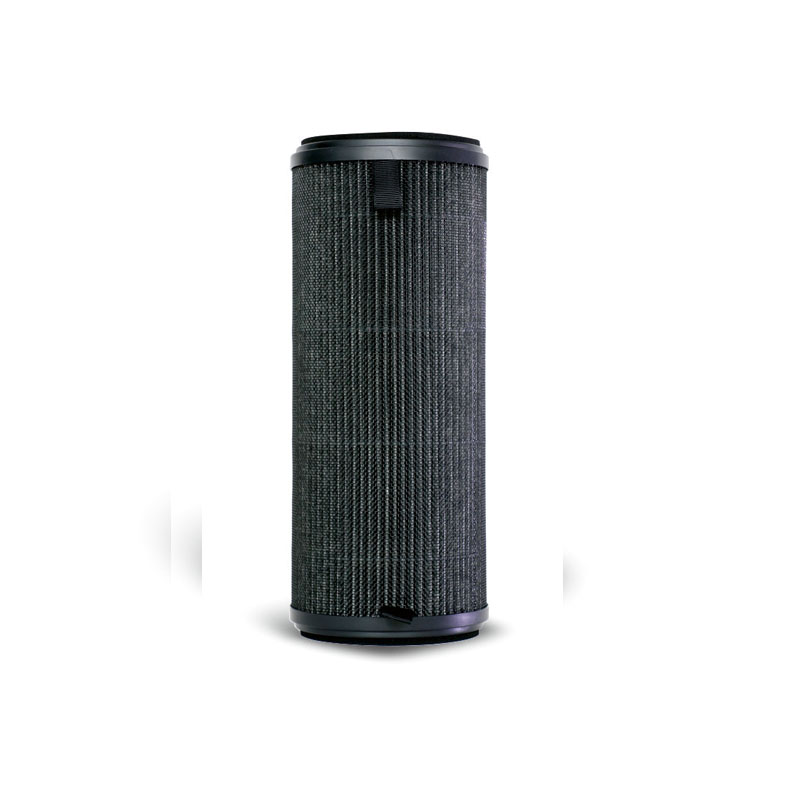
The Celrith cylindrical HEPA filter is a 360° radial-flow filter element built for car air purifiers, cup-style purifiers and desktop purifier units. It captures fine particulate matter such as PM2.5, pollen, dust and airborne bacteria from the cabin air stream, and can be supplied with an added carbon stage for formaldehyde and odour control. It is made for appliance brands, aftermarket suppliers and trading companies that need a sealing-flange filter matched to their own housing geometry rather than a catalogue size.
A car cabin is a small, closed volume with a large interior surface area and a constant supply of new contamination. Outside air entering the vehicle carries road dust, tyre and brake wear particles, diesel soot and pollen. Inside, the occupants themselves generate fine particles, and the interior trim, adhesives and upholstery release volatile organic compounds and odours that accumulate fastest when the windows are closed and the air conditioning is recirculating.
What makes this difficult is particle size. The fraction that matters most for health — the fine and ultrafine range — is also the fraction that a simple mesh or coarse foam screen will not hold. It stays airborne for long periods, is small enough to be drawn deep into the respiratory tract, and is small enough to pass straight through a low-efficiency medium. Odour and gas-phase contamination behave differently again: they are not captured by mechanical interception at all, so a particulate-only element will remove the dust while leaving the smell untouched.
The practical consequence is that a car purifier is asked to do two jobs at once — remove fine particles and reduce gases and odours — inside a housing that is deliberately compact. Anything that solves only half the problem leaves the other half circulating.
Contamination does not only affect the people in the cabin; it loads the purifier itself. Every particle the filter holds is a particle that is not coating the fan blades, the motor bearings, the sensor window or the internal ducting. When the element is undersized or poorly sealed, dust bypasses the medium and deposits on those components instead, and the unit begins to lose airflow long before the filter itself is due for replacement.
The second load is aerodynamic. A filter with a small effective area forces the fan to work harder to move the same volume of air, which raises noise and power draw and reduces the clean air delivery rate the appliance can claim. A pleat pack that is dense but shallow, or a housing that only uses part of the available circumference, wastes both filter material and blower capacity. In a car purifier, where the fan is small and the noise target is strict, this trade-off is felt immediately by the user.
The third load is on the supply chain. A filter that is glued, clipped or sized in a way that only one housing will accept becomes a single-source part with no second option, and any change to the appliance design forces a new tooling cycle. Brands that sell into several vehicle platforms feel this most acutely.
The Celrith element uses a 360° annular inlet design: air enters around the full circumference rather than through a single face. This puts the entire outer surface of the pleat pack to work, which raises the effective filtration area inside the same envelope and, in turn, supports a higher clean air delivery rate for a given fan. Because the medium is pleated at high density, the element holds more dust before the pressure drop rises, so useful service life is extended and the pleat material is used more completely.
Media selection is matched to the contaminant mix the customer expects. PP melt-blown media suits particulate-led applications and general cabin dust; PP+PET composite gives a balance of strength and efficiency where the element must survive vibration and repeated handling; PTFE is available where the highest efficiency at low resistance is required. Efficiency grades from H11 to H13 can be specified according to the terminal purifier's requirements, so the filter is sized to the performance claim the appliance needs to make rather than to a single fixed grade.
Where gas-phase contamination or odour is the priority, the element can be built as a composite: an outer or inner pre-filter layer to catch coarse dust and protect the HEPA stage, plus a cylindrical or modified activated-carbon layer aimed at formaldehyde and odour. This layered approach means the HEPA medium is not blinded by coarse debris, and the carbon is not exhausted by dust it was never meant to hold — each stage does the job it is suited to.
Dimensions are fully tooled to the customer's requirement. Outer diameter, inner diameter, height and the base sealing flange can all be set to match the housing, so the filter seats correctly and bypass is controlled at the flange rather than left to the installer.
| Item | Detail |
|---|---|
| Product name | Cylindrical HEPA filter for car air purifiers |
| Structure | 360° annular air inlet, high-density pleating, maximised effective area |
| Core media options | PP melt-blown layer; PP+PET composite; PTFE high-efficiency media |
| Filtration efficiency | H11 to H13 HEPA grades available, specified to the terminal purifier's requirement |
| Composite upgrade options | Additional inner or outer pre-filter dust screen; built-in cylindrical or modified activated-carbon layer for formaldehyde and odour control |
| Core applications | OEM and aftermarket car air purifiers, desktop compact purifiers, combined humidifier-purifier units |
| Size and dimensions | Tooled to customer requirement — outer diameter, inner diameter, height and base sealing flange design |
| Quality system | Produced in 20,000 m² of cleanrooms; IATF 16949 automotive quality management system and ISO 9001 / 14001 certified |
Celrith supplies this element to appliance brands building car air purifiers into OEM or aftermarket programmes, to cup-style and centre-console purifier makers, and to compact desktop purifier and humidifier-purifier manufacturers. It also suits trading companies and brand owners who need a filter built to their own drawing and packaged under their own label.
The common requirement across these users is fit: the filter has to match a housing that already exists or is being finalised, and it has to do so consistently across production batches. Because sizes and flanges are tooled per customer, the same element can be adapted to several purifier models without changing the underlying media strategy.
Celrith products are manufactured to meet REACH and RoHS environmental compliance requirements, and compliance documentation can be supplied with the order. The company holds ISO 9001, ISO 14001 and ISO 45001 system certification, and in 2024 obtained IATF 16949 automotive quality management system certification — the framework under which this filter is produced for car-cabin applications.
Testing is carried out in the company's own laboratory, which is accredited by CNAS (China National Accreditation Service for Conformity Assessment) and can issue reports on filtration efficiency, dust holding capacity and resistance. Production runs in a 50,000 m² plant that includes 20,000 m² of cleanrooms across six cleanroom workshops, supporting the IATF 16949 discipline this product is built under.
With more than 20 years of filtration product development and manufacturing experience and over 1,000 filtration solutions developed to date, Celrith has exported continuously to Europe, the United States, Japan and Korea for more than 20 years. Multiple automated production lines support monthly output in the millions of pieces, and quality is controlled through IQC, IPQC and OQC across the full process. The company is based in Zhongshan, Guangdong, China.
To quote accurately, we need a few details: the purifier or vehicle model the filter is intended for, the size or a drawing of the housing and sealing flange, the airflow the unit is designed to move, the operating conditions (temperature, humidity, expected contaminant mix), and the quantity you plan to order. Send these through the contact page and our team will respond with a specification and price.
The element captures fine particulate matter from the cabin air stream — PM2.5, pollen, dust and airborne bacteria — using HEPA media in H11 to H13 grades. Where a composite build is specified, an added activated-carbon layer also targets formaldehyde and odours. Coarse debris is caught by the optional inner or outer pre-filter screen before it reaches the HEPA medium.
Efficiency grades from H11 to H13 can be specified according to the terminal purifier's requirements, so the medium is matched to the performance claim the appliance needs. The 360° annular inlet and high-density pleating put the full circumference to work, which supports a higher clean air delivery rate for the same fan. Customers should confirm the target grade when ordering, as it determines the media selected.
Yes. Outer diameter, inner diameter, height and the base sealing flange are tooled to customer requirement, so the element seats correctly in the housing. Media type, HEPA grade and the carbon layer can be combined in the same build. Because the design is tooled per customer, a drawing or sample of the housing is the starting point for a quote.
Samples of existing specifications can be dispatched within 3–5 working days; tooled samples typically take 15–25 working days. To quote, we ask for the device or vehicle model, size or drawing, airflow, operating conditions and quantity. Send these through our <a href="/en/contact">contact page</a> and the team will respond with specification and price.
The MOQ for standard cylindrical HEPA filters is usually 1,000 pcs. For customised versions the MOQ is agreed separately depending on the complexity of the tooling required. Quantities and scheduling are confirmed at quotation stage.
Bulk orders generally run 25–35 days. During peak seasons we recommend placing orders earlier so production can be scheduled ahead. Lead times are confirmed against the specific specification and quantity when the order is placed.
Under normal in-car use, a replacement interval of 6–12 months is recommended. Actual life depends on the vehicle's operating environment, local air pollution levels and daily usage hours. Because the pleated medium holds more dust before resistance rises, the element retains performance longer than a shallow pleat pack of the same envelope.
The filter is produced under IATF 16949 automotive quality management system certification, obtained in 2024, with ISO 9001, ISO 14001 and ISO 45001 also held. Products meet REACH and RoHS requirements and compliance documents can be provided. Testing is carried out in the company's CNAS-accredited laboratory, which can issue reports on efficiency, dust holding capacity and resistance. For documentation specific to your order, please <a href="/en/contact">contact us</a>.