
AR

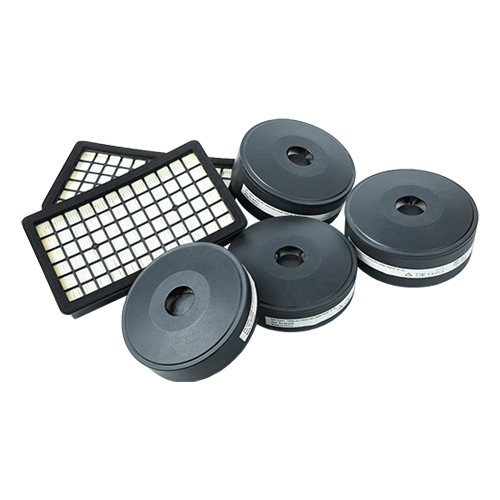
The Celrith Dust Filter Box (HEPA Grade) is a compact filtration cartridge that removes PM0.3 particles at ≥ 99.99% efficiency while also adsorbing VOCs and other gaseous contaminants. It is built for clinical ventilator and anaesthesia circuit intake, industrial respirators and positive-pressure breathing air, and high-spec fresh-air and oxygen-generation equipment. Celrith supplies it as a standard unit or as a fully customised part produced to customer drawings.
Air drawn into a ventilator, anaesthesia circuit or respirator is never clean. It carries fine dust, pollen, PM2.5 and microbial particles, and in clinical and industrial settings it also carries odours, solvent vapours and other volatile organic compounds. A single grain of grit or a film of oily vapour on a sensor or valve is enough to shift readings and shorten service life.
Particles and gases behave differently. A mechanical filter can stop the solid fraction but lets vapours pass; an adsorbent bed captures gases but clogs quickly when it is asked to hold dust. Running one without the other leaves half the load in the airstream. The Celrith filter box is built to take both fractions in one housing, so the downstream equipment sees a cleaner, more predictable supply.
For a ventilator or anaesthesia machine, the cost of contamination shows up in flow sensors, proportional valves and the patient circuit. Deposit build-up changes resistance, forces the blower to work harder and makes delivered flow drift from set values. In oxygen concentrators and fresh-air units, dust loading on the intake side reduces usable output long before the machine itself fails.
For industrial masks and positive-pressure respirators, the load is carried by the wearer: a filter that sheds or bypasses lets particles and vapours reach the breathing zone, and a poorly sealed housing lets air take the path of least resistance around the media. A filter box is only as good as its seal and its fit to the device.
Celrith builds the filter box around a high-precision PTFE microporous membrane, with high-grade glass fibre and composite activated carbon adsorption media as options in the same part. The PTFE layer does the fine particle work, holding back PM0.3 at ≥ 99.99% efficiency. The carbon layer handles VOCs and odours, so the device downstream receives air with both the particulate and gaseous load reduced.
The housing is a non-toxic ABS or PC injection-moulded shell, sealed with a medical silicone gasket joined by ultrasonic welding so the assembly does not leak past the media. Dimensions and internal structure are made to the customer's drawing, and the part is offered across HEPA grades from H13 to H14 so the efficiency level matches the device rather than being fixed by the supplier. The result is a direct contrast with a single-stage pad: one part, two contaminant routes closed, and a housing that fits the machine it was designed for.
| Item | Detail |
|---|---|
| Product name | HEPA ventilator filter / respirator cartridge (dust filter box, HEPA grade) |
| Core filter media | High-precision PTFE microporous membrane, high-grade glass fibre, composite activated carbon adsorption media |
| Core performance | Dual action: precise removal of PM0.3 particles at ≥ 99.99% efficiency |
| Grade options | HEPA filter elements from H13 to H14 |
| Main applications | Clinical ventilator and anaesthesia circuit systems, industrial respirators and positive-pressure breathing apparatus, high-spec fresh-air purification and oxygen-generation equipment |
| Customisation | Tooling and production to customer drawings; non-toxic ABS/PC injection-moulded housing; medical silicone gasket with ultrasonic welding for a leak-free seal |
| Verification and systems | Filter efficiency verified at the company's CNAS-recognised laboratory; medical supplies GMP certification; IATF 16949, ISO 14001 and ISO 45001 system certificates |
| Location | Zhongshan, Guangdong, China |
The filter box serves four groups. Medical device makers fit it to clinical ventilators and anaesthesia machines where particle and vapour control both matter. Industrial safety suppliers use it in respirators and positive-pressure breathing apparatus. Fresh-air purification and oxygen-generation equipment makers specify it where intake air quality determines output. OEM and ODM buyers come for a part built to their own drawing, with housing, media grade, logo and packaging set by their specification.
Because dimensions follow the customer's drawing, the same construction serves devices of different footprints. That flexibility is the point: the customer defines the envelope and the grade, and Celrith tooling and production follow.
Celrith products are designed to meet REACH and RoHS environmental requirements, and compliance documents can be supplied on request. The company holds ISO 14001 and ISO 45001 system certificates and, from 2024, IATF 16949 automotive quality management certification.
Filter efficiency is verified at the company's own CNAS-recognised laboratory, which can issue reports covering efficiency, dust holding capacity and resistance. Manufacturing runs in a 50,000 m² plant that includes 20,000 m² of cleanrooms across six clean workshops, and quality control follows IQC, IPQC and OQC stages through production. With more than 20 years of filter development and manufacturing and over 1,000 filter solutions developed to date, Celrith supplies these parts from Zhongshan, Guangdong, China to customers in Europe, the United States, Japan and Korea.
To quote accurately, send us the device or vehicle model the filter will serve, the required size or a drawing, the airflow or water flow the part must handle, the operating conditions it will see, and the quantity you expect to order. With those details we can confirm grade, housing and seal options and return a quotation.
Contact Celrith with your specification and we will respond with the next steps.
It removes PM0.3 particles at ≥ 99.99% efficiency through a high-precision PTFE microporous membrane, and it also adsorbs VOCs and odours with composite activated carbon media. The two functions sit in one housing, so both the particulate and gaseous load are reduced before air reaches the device.
The filter box is offered across HEPA grades from H13 to H14, and the media combination can be specified with PTFE, glass fibre and activated carbon. Efficiency is verified at the company's CNAS-recognised laboratory. Tell us the particles and gases your device must handle and we can advise on the grade.
Yes. Dimensions and structure are produced to the customer's drawing, with a non-toxic ABS or PC injection-moulded housing and a medical silicone gasket joined by ultrasonic welding for a leak-free seal. Logo and packaging can also be customised under OEM/ODM arrangements.
Existing specifications can be supplied as samples for evaluation, with freight payable by the customer. Custom samples are agreed according to development complexity, so quality can be checked before a production order is placed. Send your drawing or device model to start the sample request.
Standard items typically start at 1,000 PCS, while customised items are set by negotiation depending on tooling. Stock items usually ship in about 7–15 days, and customised batch orders generally take 25–35 days. Confirm the quantity and specification with us for a firm schedule.
Replacement interval depends on the dust and vapour load at the intake and on the device's own service schedule, so it should be set per application rather than as a single figure. Because the part is made to your drawing, we can discuss the media area and grade that suit your expected replacement cycle.
Quality control follows IQC, IPQC and OQC stages, and the CNAS-recognised laboratory can test efficiency, dust holding capacity and resistance, with reports supplied. Production runs in a 50,000 m² plant that includes 20,000 m² of cleanrooms, supporting repeatable output for long-term orders.
Celrith has more than 20 years of filter development and manufacturing experience and has exported to Europe, the United States, Japan and Korea for over 20 years. The company holds ISO 14001, ISO 45001 and, from 2024, IATF 16949 certification, and its products are designed to meet REACH and RoHS requirements. Contact us with your specification to discuss your market's needs.