
AR

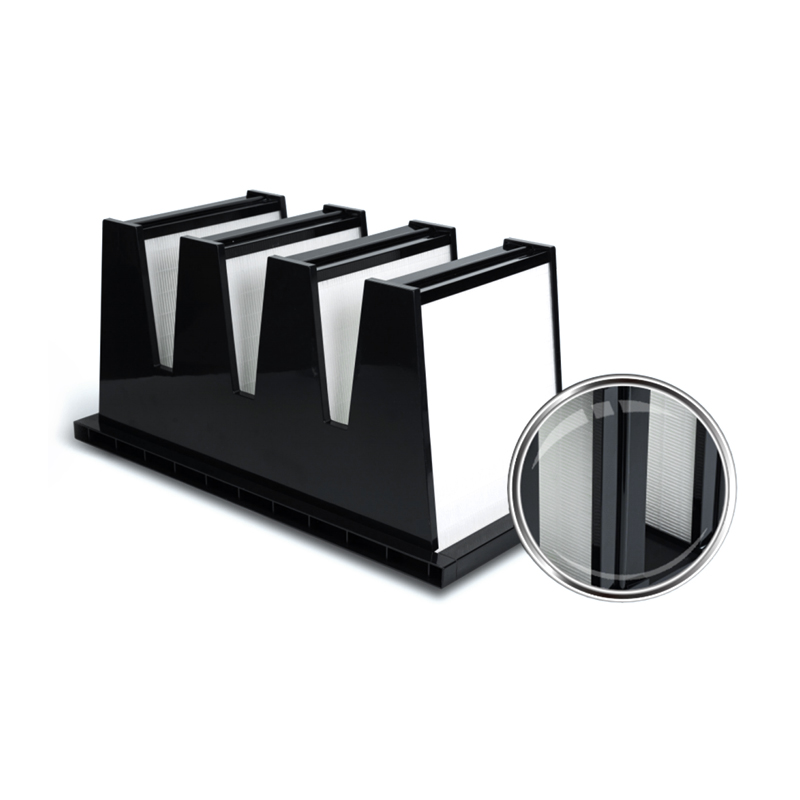
The Celrith V-Type High Efficiency Filter is a V-bank air filter that removes fine particles, aerosols and airborne contaminants from ventilation and cleanroom air. It is available in efficiency classes from M6 to H14 and is designed for high-airflow systems in semiconductor, pharmaceutical, healthcare, automotive and commercial HVAC applications. Facility managers, HVAC engineers and contamination-control specialists specify it where high efficiency must be combined with low energy use.
Airborne particles are not a single problem. In a semiconductor cleanroom, sub-micron particles can bridge circuit features and cause yield loss. In a hospital operating theatre, bacteria-carrying aerosols pose infection risks. In a pharmaceutical GMP workshop, cross-contamination can invalidate a batch. In commercial buildings, fine dust and pollen reduce indoor air quality and strain HVAC systems.
Gaseous and odourous contaminants also matter. While the Celrith V-Type filter is primarily a particle filter, its high-efficiency glass-fibre media capture the fine fraction that often carries odours and irritants, and it can be combined with separate gas-phase stages where required. The key is to remove contaminants before they reach critical spaces or sensitive equipment.
When particles are not captured efficiently, they deposit on heat-exchange coils, fans and ductwork. This fouling reduces heat-transfer efficiency, increases fan power and can lead to unscheduled cleaning or downtime. In gas-turbine intake systems, fine dust and salt aerosols erode compressor blades and reduce output. In cleanrooms, particle breakthrough forces higher air-change rates or additional filtration stages, both of which raise energy costs.
The filter itself must also handle aerodynamic load. A low-efficiency, high-resistance filter increases pressure drop and fan energy. A poorly sealed filter allows bypass, so contaminants reach the clean space regardless of media efficiency. The V-bank design addresses both: it provides a large media area in a compact footprint, and the rigid frame maintains a reliable seal under high airflow.
Celrith uses high-quality ultra-fine glass-fibre filter paper, which delivers high particle capture efficiency across the M6–H14 range. The V-bank configuration arranges multiple filter panels in a V-shape, increasing effective media area by a factor of two to three compared with conventional box filters. This larger area lowers initial resistance and raises dust-holding capacity, so the filter lasts longer and consumes less fan energy over its service life.
The frame is available in ABS high-strength plastic or galvanised iron. Both options are engineered to withstand a rated operating velocity of 2.5 m/s, making the filter suitable for high-volume air-handling units, fan-filter units and make-up air systems. The rigid construction helps prevent media damage and bypass, supporting consistent efficiency in demanding installations.
| Item | Detail |
|---|---|
| Product name | V-Bank / V-Cell Medium & HEPA Air Filter |
| Filter efficiency | M6 / F7 / F8 / F9 / E10 / E11 / H13 / H14 |
| Core filter media | High-quality ultra-fine glass-fibre filter paper |
| Frame material | ABS high-strength plastic / galvanised iron |
| Rated operating air velocity | 2.5 m/s (designed for high-airflow, high-throughput systems) |
| Typical applications | Pharmaceutical GMP workshops, semiconductor cleanrooms, hospital operating theatres, gas-turbine intake systems, commercial building central air-handling units (AHU) |
| Common size references (W × H × D) | 24×24×12 in (592 × 592 × 292 mm) 20×24×12 in (490 × 592 × 292 mm) 12×24×12 in (287 × 592 × 292 mm) |
| Production certification & customisation | Own CNAS national testing centre; ISO 9001 and IATF 16949 certified. Full OEM customisation of non-standard sizes, efficiencies and airflows. |
The Celrith V-Type filter serves industries where air quality directly affects product quality, safety or regulatory compliance. Semiconductor and microelectronics fabs use it in cleanrooms to protect wafer processes. Pharmaceutical manufacturers install it in GMP workshops to prevent cross-contamination. Hospitals rely on it in operating theatres and critical care areas. Automotive and mechanical manufacturing plants use it in paint shops and engine test cells. Energy and metal-smelting facilities apply it in gas-turbine intake systems and control rooms. Data centres and AI computing facilities use it to protect servers from particulate fouling. Commercial HVAC systems in offices, airports and shopping centres benefit from its low resistance and high dust-holding capacity.
Each application has different requirements for efficiency, airflow and frame type. Celrith supports full OEM/ODM customisation: size, V-bank count, filter class, frame material, logo and packaging can all be tailored. With over 1,000 filter solutions developed, the engineering team can match a filter to your specific contaminant profile and system constraints.
Celrith products comply with REACH and RoHS environmental regulations, and compliance documentation is available on request. The company holds ISO 9001, ISO 14001 and ISO 45001 certifications, and in 2024 obtained IATF 16949 automotive quality management certification. A dedicated CNAS-accredited laboratory provides filter efficiency, dust-holding capacity and resistance test reports, giving customers traceable performance data.
Manufacturing takes place in a 50,000 m² plant in Zhongshan, Guangdong, China, which includes six cleanrooms totalling 20,000 m². This controlled environment prevents secondary contamination during assembly. Multiple automated production lines support a monthly capacity of millions of units. Quality control covers IQC, IPQC and OQC throughout the process. With over 20 years of filtration experience, Celrith has been exporting to Europe, the United States, Japan and South Korea for more than two decades.
To recommend the right Celrith V-Type filter for your system, we need a few details: your device or vehicle model, required size or a drawing, airflow or water-flow rate, operating conditions (temperature, humidity, contaminants), and estimated quantity. Share these with our team through the contact page, and we will respond with a tailored proposal.
The Celrith V-Type filter removes fine particulate matter, aerosols and airborne contaminants from air. Its glass-fibre media captures sub-micron particles, making it suitable for cleanrooms, hospitals and industrial ventilation. For gaseous contaminants, it can be combined with separate gas-phase filtration stages.
Celrith offers the V-Type filter in M6, F7, F8, F9, E10, E11, H13 and H14 efficiency classes. This range covers medium-efficiency pre-filtration through high-efficiency particulate air (HEPA) filtration. Custom efficiencies outside this range can be discussed with the engineering team.
Yes, Celrith provides full OEM/ODM customisation. You can specify non-standard sizes, V-bank count, filter class, frame material (ABS plastic or galvanised iron), logo and packaging. The team will work from your airflow, resistance and installation-space requirements to propose a solution.
Replacement interval depends on pre-filtration, dust load and operating airflow. Under a typical G4+F8 pre-filter arrangement, service life can reach 2–3 years. Replace when final resistance reaches twice the initial resistance (typically around 500–600 Pa) or when system airflow falls below 85% of design value.
For standard sizes, the MOQ is typically 10 pieces, which allows for testing and validation. Customised models generally require 50–100 pieces. Celrith aims to keep MOQs practical for both trial orders and volume production.
Standard stock models ship within 5–7 working days. Custom products are produced in 15–25 working days after drawing approval. Large orders can be scheduled in batches to match your project timeline.
Yes, Celrith welcomes sample testing. For standard sizes, 1–2 free samples are available (customer pays freight). Custom samples are quoted based on complexity, and the sample fee can be credited against a subsequent order. Each sample includes a full test report from the CNAS-accredited laboratory.
Please provide your device or vehicle model, required size or drawing, airflow or water-flow rate, operating conditions and quantity through the <a href="/en/contact">contact page</a>. Our team will review your requirements and respond with a detailed proposal.