
AR

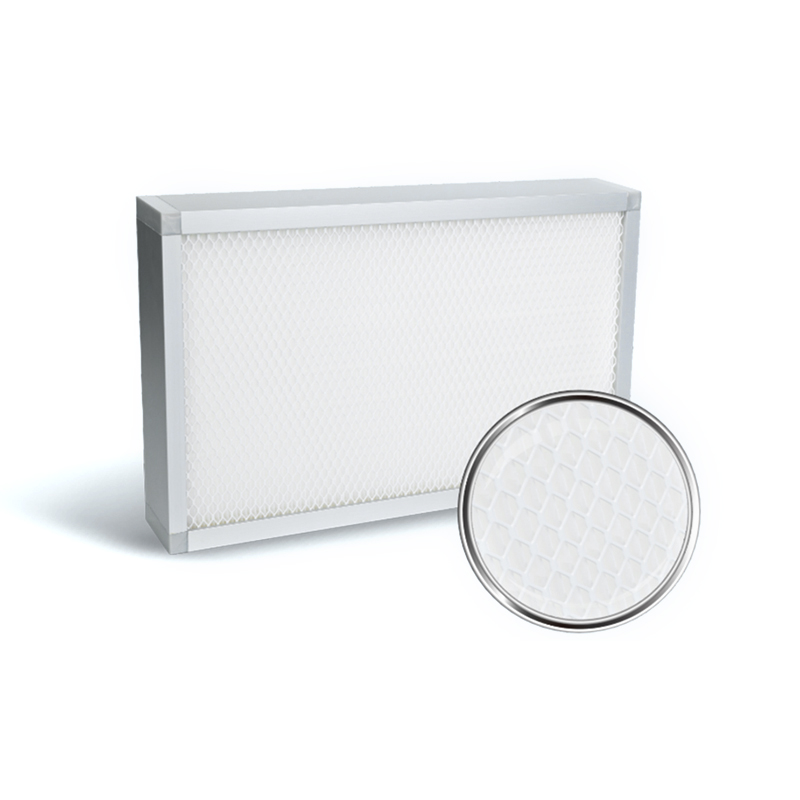
Celrith no-partition medium efficiency filters are mini-pleat panel filters built from fiberglass or PTFE media in an anodised aluminium or stainless steel frame, rated M6 to E11. They capture particles at micron level while adding very little resistance to the air stream, which protects downstream coils, ductwork and high-efficiency filter stages. They are made for HVAC and ventilation systems, cleanroom pre-filtration, GMP workshops, hospital operating rooms, FFU units and electronics or semiconductor plants. Celrith manufactures them in Zhongshan, Guangdong, China.
Air moving through a building carries more than dust. Coarse grit, fine particulate, lint, soot, pollen and, in some processes, odour-bearing or gaseous traces all travel with it. In a hospital operating room, a pharmaceutical GMP workshop, a semiconductor cleanroom or a data centre, that load matters because it settles where it is least welcome: on heat-exchange surfaces, inside duct runs, on fan blades and at the face of the final high-efficiency stage. Waterborne impurities follow the same logic in process water and cooling loops, where suspended solids build films and deposits that reduce thermal performance.
The visible contaminant is rarely the costly one. The fine fraction, roughly the range below a few microns, is what stays airborne longest, penetrates deepest and loads filters fastest. That is the fraction a medium efficiency stage is designed to take out before it reaches the equipment that cannot easily be cleaned.
Every filter upstream of a coil or a fan is doing two jobs at once: cleaning the air and shielding the asset. When the first stage is too coarse or too thin on media area, the consequences show up downstream. Coils foul, static pressure rises, fans work harder, energy consumption climbs and the final high-efficiency filter changes out sooner than planned. In cleanrooms and FFU units, the same chain reaction threatens particle counts at the critical zone.
A filter that relieves this load needs three things working together: fine enough capture, enough pleat area to hold dust without choking, and low initial resistance so the system does not pay for filtration twice. Mini-pleat construction with hot-melt adhesive separators gives a high media area inside a thin frame, so the filter fits into tight plenum space and still offers a large dust-holding surface. The result is a gentler pressure curve over the service interval and less strain on the air-handling unit.
Celrith builds the medium efficiency range around low air resistance for energy savings and micron-level interception. The pleat pack is formed from quality fiberglass or PTFE media and held by quality hot-melt adhesive instead of aluminium separators, which keeps weight down, removes a common source of damage and leaves more of the frame open to airflow. The anodised aluminium profile or stainless steel frame is slim, so the filter occupies less space in the duct or AHU section.
The efficiency range runs from M6 to E11, covering medium efficiency through sub-high efficiency duty. That spread lets a single supplier serve a layered filtration strategy: a medium stage to carry the bulk of the particulate load, and a higher stage behind it to finish the job. Because the pleat pack is bonded rather than partitioned, the filter resists deformation in service and is straightforward to replace without special tools.
For projects that do not fit a catalogue size, Celrith offers non-standard dimensions and OEM service, drawing on the company's 20000 m² of cleanroom workshops and its CNAS-accredited testing centre. 50 mm and 70 mm depth options are available across the standard range, and other sizes can be developed to drawing.
| Item | Detail |
|---|---|
| Product type | High-efficiency pleated panel filter without partitions (mini-pleat panel filter) |
| Core media | Quality fiberglass or PTFE |
| Frame material | Anodised aluminium profile or stainless steel |
| Separator | Quality hot-melt adhesive |
| Efficiency class | M6 to E11, covering medium efficiency through sub-high efficiency |
| Typical applications | Microelectronics and semiconductor cleanrooms, pharmaceutical GMP workshops, hospital operating rooms, high-end commercial building HVAC systems, FFU units |
| Standard sizes and rated airflow (width × height × depth) | 305 × 610 × 50 mm (rated airflow 350 CMH); 610 × 610 × 50 mm (750 CMH); 1170 × 570 × 50 mm (1300 CMH); 1170 × 1170 × 70 mm (3600 CMH). Further sizes are available in 50 mm or 70 mm thickness options. |
| Customisation | Non-standard dimensions and OEM service to customer requirements, supported by the company's 20000 m² cleanroom workshops and CNAS national testing centre |
Celrith products are made to meet REACH and RoHS environmental compliance requirements, and compliance documentation can be supplied with orders. The company holds ISO 9001, ISO 14001 and ISO 45001 system certification, and added IATF 16949 automotive quality management certification in 2024.
Testing is carried out in the company's own CNAS-accredited laboratory, which issues reports covering filtration efficiency, dust-holding capacity and resistance. Production runs in a 50000 m² plant that includes six cleanrooms totalling 20000 m², with multiple automated production lines capable of millions of pieces per month. Quality control follows IQC, IPQC and OQC through the full process.
With more than 20 years of filtration development and manufacturing experience, Celrith has continued to export to Europe, the United States, Japan and Korea for over 20 years, and has developed more than 1000 filtration solutions. The company supports OEM/ODM work covering dimensions, structure, media grade, frame material, logo and packaging.
To get an accurate recommendation and quotation, send us the device or vehicle model, the size you need or a drawing, the airflow or water flow involved, your operating conditions and the quantity required. Our team will match the filter grade and configuration to your application and confirm lead time. Contact Celrith to start the conversation.
It removes micron-level particulate from the air stream, including fine dust, lint and other suspended solids, using fiberglass or PTFE media in a mini-pleat pack. The M6 to E11 range covers medium through sub-high efficiency duty, so the grade can be matched to the particle size and load of your process. It is typically used ahead of a final high-efficiency stage or as the main filter in commercial HVAC systems.
The mini-pleat design packs a large media area into a thin frame, giving low initial resistance and a high dust-holding surface. That means fans work against less pressure and downstream coils and final filters receive cleaner air for longer. The no-partition construction with hot-melt adhesive separators also keeps the filter light and stable in service.
Yes. Celrith offers non-standard dimensions and OEM service, covering media grade, frame material, dimensions, logo and packaging. Development is supported by 20000 m² of cleanroom workshops and the company's CNAS testing centre. Standard options include 50 mm and 70 mm thicknesses, and further sizes can be produced to drawing.
Yes. Send your device or vehicle model, required size or drawing, airflow, operating conditions and quantity, and the team will confirm the suitable grade and price. Sample arrangements and quotation terms are set per project, so it is best to describe the application in detail. Use the contact page to submit your request.
MOQ depends on whether you order a standard size or a custom build. Celrith's team will confirm the MOQ for your specific configuration together with the quotation. Requirements for new customers and sample orders can be discussed case by case.
Lead time depends on the size, grade and quantity ordered, and is confirmed with the quotation. Custom builds generally require a development step before production. Share your required delivery date with the inquiry so it can be factored in.
Replacement depends on the dust concentration, airflow and running hours of your system, so there is no single interval. Monitor pressure drop across the filter and replace when it reaches the change-out value set for your installation. Keeping a spare set on hand avoids extended downtime.
The grade depends on what is downstream: a medium grade is often enough as a pre-filter ahead of a high-efficiency stage, while cleanroom and FFU duties may call for a higher grade in the M6 to E11 range. Tell us your particle target and system layout and we will recommend a grade. Contact Celrith with your specifications to confirm.