
AR

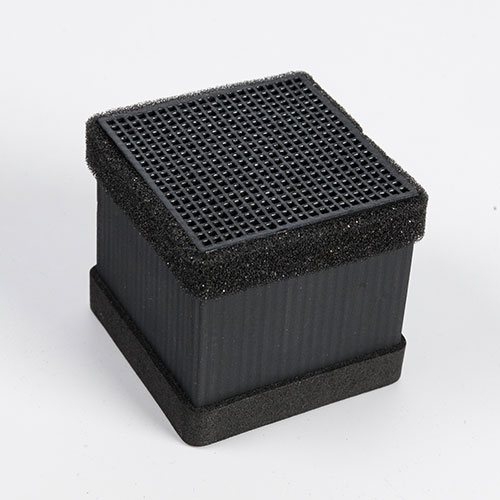
Celrith sintered activated carbon block filters are high-performance air filters that remove ozone, volatile organic compounds (VOCs), formaldehyde, and odour molecules from the air passing through them. They are made from a high-iodine coconut-shell carbon core combined with an ultrafine dust filtration layer, sintered at high temperature into a rigid block. They are designed for original equipment manufacturers and aftermarket suppliers of printers and copiers, range hoods and integrated stoves, refrigerators, air purifiers, and vehicle cabin air systems. Celrith is a brand of a filtration manufacturer based in Zhongshan, Guangdong, China, with over 20 years of experience in filtration solutions.
Airborne contaminants are not just an odour nuisance; they are a load on equipment and a risk to indoor air quality. In printers and copiers, the high-voltage corona discharge during operation generates ozone (O₃), a reactive gas that can irritate the respiratory system and accelerate the degradation of rubber and plastic components inside the machine. VOCs and formaldehyde are released from toners, inks, adhesives, and construction materials, contributing to a chemical smell and long-term health concerns. In kitchens, cooking fumes carry grease particles, odours, and VOCs that cling to surfaces and recirculate in recirculating range hoods. Refrigerators trap food odours and ethylene gas, which can affect the taste of stored food. Vehicle cabins accumulate exhaust gases, pollen, and fine dust from the road.
Each of these environments places a specific demand on a filter: it must capture the targeted contaminant without creating excessive airflow resistance that would force the equipment to work harder. A filter that removes particles but not gases, or that removes gases but clogs quickly with dust, leaves part of the problem unsolved.
When contaminants are not effectively removed, the consequences show up as increased maintenance, reduced component life, and higher energy consumption. Ozone and VOCs can corrode electrical contacts and degrade seals in office equipment, leading to premature failures. Grease and odour molecules in kitchen exhaust can coat fan blades and motors, reducing efficiency and creating fire hazards. In refrigerators, odour molecules circulate continuously and can be absorbed by food, while ethylene gas speeds up ripening and spoilage. In vehicle cabins, a loaded cabin filter restricts airflow, causing the HVAC blower to draw more current and reducing heating or cooling performance.
Conventional filters often trade one performance area for another. Granular activated carbon loose-fill filters can shed carbon dust into the airstream, contaminating sensitive components. Activated carbon fibre felts may have lower adsorption capacity per unit volume and can be less effective against small molecule gases like ozone. Pleated HEPA filters capture particles well but offer limited gas removal unless combined with a separate carbon stage, which adds bulk and pressure drop. The challenge is to combine particle and gas removal in a single, stable, low-resistance medium.
Celrith sintered activated carbon block filters address these challenges through a one-piece sintered construction. High-iodine coconut-shell activated carbon is mixed with a thermoplastic binder and sintered at high temperature to form a rigid block with uniform density. This structure eliminates the risk of carbon fines breaking away and contaminating downstream equipment, a common issue with loose-fill carbon. The block is combined with an ultrafine fibre layer that captures dust, PM2.5, and other particles, so a single filter handles both particulate and gaseous contaminants. This dual function can reduce the number of filter stages required, saving space and simplifying maintenance.
The sintering process creates a porous structure with a high surface area for adsorption. The coconut-shell carbon has an iodine number of 1000 mg/g or higher, indicating a high micropore volume suitable for capturing small molecules such as ozone and formaldehyde. The block's uniform density ensures that airflow is distributed evenly across the filter face, avoiding channelling and bypass that can reduce efficiency. The result is stable performance over the filter's service life.
Low air resistance is a key design goal. The sintered block is engineered to maintain low pressure drop at typical operating airflow rates, reducing the load on fans and blowers. This helps equipment meet energy efficiency targets and reduces noise. For printers and copiers, the low resistance means the cooling fan does not need to work harder to maintain internal temperatures. For range hoods, it allows the use of recirculating configurations without excessive loss of extraction power.
Celrith offers extensive customisation. Filters can be produced in rectangular, circular, or irregular shapes, with various thicknesses and frame materials (plastic, metal, or paper). The carbon grade and fibre layer can be selected to balance adsorption capacity, pressure drop, and service life for specific applications. This flexibility allows OEMs to integrate the filter into existing product designs without major modifications.
| Item | Detail |
|---|---|
| Core product name | Sintered carbon block / activated carbon HEPA composite filter |
| Filter media composition | High-efficiency dust-retaining ultrafine fibre layer + high-iodine coconut-shell activated carbon core |
| Process and structure | One-piece high-temperature sintering, anti-dust-shedding technology, very low air resistance |
| Typical applications | Fresh air system pre-filters and high-efficiency filters, vehicle cabin air filters, high-end odour-removal vacuum cleaners, household and commercial air purifiers |
| Target contaminants | Dust, particulate matter, PM2.5, formaldehyde, VOCs (volatile organic compounds), odour molecules |
| Factory certifications | ISO 9001 / ISO 14001 / ISO 45001 / IATF 16949 / CNAS-accredited laboratory |
| Procurement and customisation | Filter structure development, specification customisation, drawing- and sample-based processing (OEM / ODM) |
Celrith sintered activated carbon block filters are used across a range of air treatment applications. In office equipment, they are installed in printers and copiers to remove ozone and VOCs generated during printing, protecting internal components and improving indoor air quality. In kitchen ventilation, they serve as odour removal filters in range hoods and integrated stoves, capturing grease particles, odours, and VOCs from cooking fumes. In refrigeration, they are used in refrigerators to eliminate food odours and ethylene gas, helping to keep food fresh. In air purification, they are used in household and commercial air purifiers and fresh air systems to remove dust, PM2.5, formaldehyde, and VOCs. In automotive applications, they are used in vehicle cabin air filters to reduce exhaust gases, pollen, and fine dust from entering the cabin. High-end vacuum cleaners also use these filters to trap fine dust and odours from the exhaust air.
The common thread is a need for reliable, low-maintenance removal of both particles and gases in equipment where space is limited and airflow resistance matters. Celrith works with OEMs and aftermarket suppliers to tailor the filter to the specific contaminant profile and operating conditions of each application.
Celrith products are manufactured in a facility that meets stringent quality and environmental standards. The company holds ISO 9001, ISO 14001, and ISO 45001 certifications and was awarded IATF 16949 certification in 2024. Products comply with REACH and RoHS environmental regulations, and compliance documentation is available upon request. The on-site laboratory is accredited by CNAS (China National Accreditation Service for Conformity Assessment) and can issue test reports for filtration efficiency, dust holding capacity, and pressure drop. The manufacturing base covers 50,000 m², including six cleanrooms totaling 20,000 m², ensuring a controlled production environment. With over 20 years of experience in filtration product development and manufacturing, and a track record of continuous exports to Europe, the United States, Japan, and South Korea for more than 20 years, Celrith has developed more than 1,000 filtration solutions. The company supports OEM/ODM projects with customised dimensions, structures, filter media grades, frame materials, logos, and packaging. Multiple automated production lines provide a monthly capacity of several million pieces, supported by IQC, IPQC, and OQC quality control throughout the process.
To discuss your application and receive a tailored solution, please contact our team. We will need the following information to provide an accurate quotation and recommendation:
Please contact us with these details, and our engineers will respond promptly with a proposal.
It removes dust, particulate matter including PM2.5, formaldehyde, VOCs (volatile organic compounds), and odour molecules. The high-iodine coconut-shell carbon core is particularly effective against small-molecule gases such as ozone, with a removal efficiency of over 95% in single pass for ozone in printer and copier applications. The ultrafine fibre layer captures fine particles, providing dual-function filtration in one medium.
The sintered block is a rigid, one-piece structure that eliminates the risk of carbon dust shedding, which can contaminate sensitive equipment. It provides uniform density for consistent airflow and adsorption, avoiding channelling and bypass. Compared with carbon felt, the sintered block typically offers higher adsorption capacity per unit volume and longer service life, often 6–12 months depending on the application.
Yes, Celrith supports full OEM/ODM customisation. We can produce filters in various shapes (rectangular, circular, irregular), thicknesses, and frame materials (plastic, metal, paper) based on your drawings, samples, or device model. Filter media grade and structure can be adjusted to meet specific airflow and contaminant removal requirements. Logo and packaging customisation are also available.
The MOQ for standard models is typically 500–1,000 pieces; for custom models, MOQ is negotiated based on specifications. Standard samples can be provided free of charge for evaluation, while custom samples may incur a development fee. Sample lead time is usually 7–15 working days, and bulk orders are delivered in 25–35 days depending on complexity.
Replacement interval depends on the operating environment, contaminant concentration, and airflow. In typical applications, we recommend replacement every 6–12 months or according to the equipment's cumulative operating hours. Celrith can provide life testing data and replacement recommendations based on your specific conditions.
Celrith holds ISO 9001, ISO 14001, and ISO 45001 certifications, and was awarded IATF 16949 in 2024. Products comply with REACH and RoHS regulations, and we can provide compliance documentation and test reports from our CNAS-accredited laboratory. These support export to Europe, the United States, Japan, and South Korea.
We implement IQC, IPQC, and OQC throughout production, starting with incoming activated carbon tested for iodine number, ash, and moisture. Production takes place in six cleanrooms totaling 20,000 m², and finished products are sampled according to AQL standards with test reports issued. Our CNAS-accredited lab performs ozone removal, pressure drop, and penetration testing to verify performance.
Yes, our technical team can assist with filter selection, operating condition analysis, and failure analysis. Please provide your device model, dimensions or drawing, airflow rate, operating conditions, and estimated quantity through our <a href="/en/contact">contact page</a>, and we will recommend a suitable solution and provide a quotation.