
AR

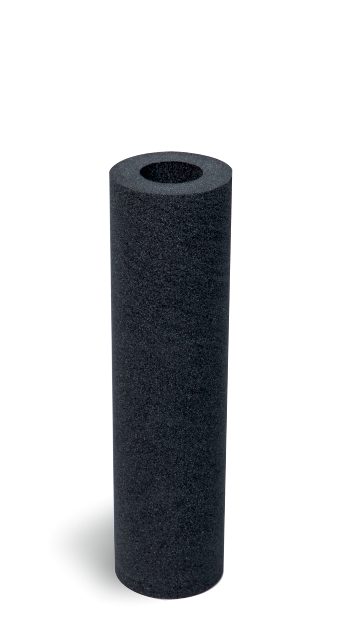
Celrith’s sintered activated carbon rod (Ф32×126) is a coconut-shell carbon block filter element designed to reduce chlorine, odour, colour, and heavy metals while softening water through built-in ion exchange resin. It is used as a pre- or post-filter in household reverse osmosis systems, direct drinking machines, refrigerators with built-in water dispensers, and commercial coffee machines. If you are sourcing a compact, customisable carbon block for water purification, Celrith provides a solution that targets both taste and scale problems.
Municipal water often carries residual chlorine from disinfection, which reacts with organic matter to form unpleasant tastes and odours. In hard-water areas, dissolved calcium and magnesium cause scale buildup, while trace heavy metals such as lead and mercury may be present from pipe corrosion. These contaminants not only affect the taste and safety of drinking water but also put stress on downstream equipment.
For appliances like refrigerators and coffee machines, the consequences are visible: scale clogs small orifices, chlorine degrades rubber seals and plastic components, and odour transfers to ice or brewed beverages. A filter that addresses only one of these issues leaves the system vulnerable. Celrith’s carbon rod combines adsorption and softening in a single cartridge, reducing the overall contaminant load before it reaches sensitive parts.
When water passes through a purifier without adequate treatment, the cumulative effect on equipment is significant. Chlorine and its by-products can oxidise elastomers and membranes, shortening the life of RO membranes and seals. Scale deposits reduce flow through narrow passages, forcing pumps to work harder and increasing energy consumption. In coffee machines, scale alters brewing temperature and extraction, while chlorine affects aroma and flavour.
For refrigerator water dispensers, the small internal tubing and valves are particularly susceptible to clogging. A filter with high adsorption capacity and softening capability reduces these risks by removing the contaminants before they can deposit or react. The result is more stable performance and fewer maintenance interventions.
Celrith’s sintered carbon rod is made from high-iodine-value coconut shell activated carbon and food-grade ion exchange resin, bonded through a sintering process that creates a uniform microporous structure. This structure provides a high initial flow rate and efficient filtration, with strong adsorption of chlorine, odours, and organic compounds. The ion exchange resin softens water by capturing calcium and magnesium ions, helping to prevent scale formation, and also assists in reducing heavy metals like lead and mercury.
Unlike loose granular carbon, the sintered rod does not release fine carbon particles (black dust) into the water, keeping downstream components clean. The block is available in a wide range of outer diameters and lengths, including the Ф32×126 size, and can be customised with end caps and welding to fit specific housings. Celrith supports OEM/ODM projects, allowing adjustments to dimensions, inner/outer diameter ratios, and end-cap configurations to match your equipment design.
| Item | Detail |
|---|---|
| Product name | Sintered activated carbon rod water filter (carbon block / CTO filter) |
| Core filtration materials | High-iodine-value coconut shell activated carbon + food-grade ion exchange resin |
| Core performance | Softens water and inhibits scaling; strongly adsorbs residual chlorine (bleaching powder); removes abnormal colour and odour; intercepts harmful heavy metals such as lead and mercury |
| Precision and filter life | Uniform microporous structure, high initial flow rate, high filtration precision, no black dust release; large saturation capacity for long service life |
| Standard size reference (outer diameter × length, mm) | Ф60×130 / Ф62×240 / Ф37.5×75 / Ф38×57 / Ф40×195 / Ф51×127 / Ф32×126 / Ф32×106 |
| Main end applications | Household reverse osmosis water purifiers (pre-filter CTO / post-filter T33), direct drinking machines, side-by-side refrigerators with built-in water filters, commercial coffee machines |
| Customisation service | Full OEM/ODM support. Length, diameter, and inner/outer diameter ratios can be tooled to equipment requirements; end-cap welding customisation available. |
| Quality certification | Company’s 20,000 m² production base is ISO 9001 and IATF 16949 certified. Filter materials meet strict drinking water safety and hygiene standards, backed by a national-level CNAS testing centre. |
This carbon rod is typically specified by manufacturers and brand owners of household water purifiers, refrigerator water systems, and commercial beverage equipment. In RO systems, it is often used as a pre-filter (CTO) to protect the membrane from chlorine and particles, or as a post-filter (T33) to polish taste. Refrigerator manufacturers use it in built-in water dispensers where space is limited and a compact, reliable filter is needed. Commercial coffee machine operators value the combination of chlorine removal and scale reduction, which helps maintain consistent brew quality.
Because the rod can be produced in custom sizes and with different end-cap designs, it also suits OEM projects where a standard cartridge does not fit. Celrith’s engineering team can work with your specifications to develop a filter that matches your housing and performance targets.
Celrith operates a 50,000 m² manufacturing facility in Zhongshan, Guangdong, China, which includes 20,000 m² of cleanroom space across six workshops. The company holds ISO 9001, ISO 14001, and ISO 45001 certifications, and has been IATF 16949 certified since 2024. Products comply with REACH and RoHS regulations, and compliance documentation can be provided upon request.
Quality control is carried out through IQC, IPQC, and OQC processes, and the company’s CNAS-accredited laboratory supports filter performance testing. With over 20 years of experience in filtration and more than 1,000 filtration solutions developed, Celrith supplies customers in Europe, the United States, Japan, and Korea. Multiple automated production lines enable a monthly capacity of millions of pieces, supporting both standard and custom orders.
To receive a tailored quote for the Ф32×126 sintered activated carbon rod or a custom size, please share the following details with our team: your device or vehicle model (if applicable), required dimensions or a drawing, target airflow or water flow rate, operating conditions (such as water quality and temperature), and estimated quantity. This information helps us recommend the most suitable configuration and provide accurate pricing and lead time. Contact us to start the conversation.
It adsorbs residual chlorine (bleaching powder), odours, abnormal colour, and organic compounds, and the built-in ion exchange resin helps soften water by reducing calcium and magnesium while also intercepting heavy metals such as lead and mercury. The sintered block does not release black carbon dust.
The product has a uniform microporous structure that provides high initial flow and high filtration precision. Specific efficiency data can be provided through testing at Celrith’s CNAS-accredited laboratory upon request.
Yes, Celrith offers full OEM/ODM customisation. Outer diameter, length, inner/outer diameter ratios, and end-cap welding can be adapted to your housing. The standard size range includes Ф30 to Ф60, and custom tooling is available.
Under typical municipal water conditions, a replacement interval of 6 to 12 months or after treating approximately 2,000 to 4,000 litres is recommended. Actual life depends on water quality and usage; Celrith can provide life testing and recommendations based on your target market.
For standard models, the MOQ is typically 1,000–2,000 pieces, while custom models start at 5,000 pieces. Standard stock items ship in 7–15 days; custom orders generally take 25–35 days for production.
Yes, samples are available for evaluation. To receive a quote, please provide your device model, required dimensions or drawing, flow rate, operating conditions, and estimated quantity. Our team will respond promptly with pricing and lead time.
The carbon rod is produced in a facility certified to ISO 9001 and IATF 16949, and the materials meet food-grade safety standards. The company also holds ISO 14001 and ISO 45001, and products comply with REACH and RoHS. CNAS laboratory testing reports can be provided.
Each carbon rod is individually sealed in a food-grade PE bag, then packed in cartons with EPE or pearl wool protection to prevent damage. Outer cartons can be printed with your branding and shipping marks, and moisture-proof measures are available for sea freight.