
AR

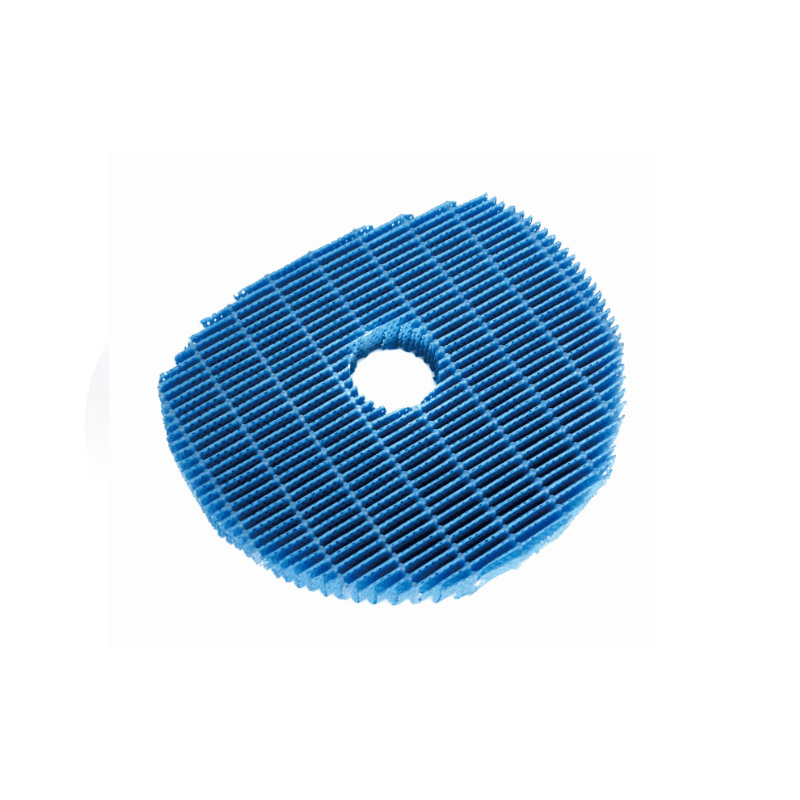
Celrith rotary humidifier filters (spunlace fabric) are evaporative wicks that remove waterborne calcium and magnesium ions, suppress bacteria and mould, and deliver clean, white-powder-free moisture. They are designed for cold-evaporation humidifiers, air purifiers with humidification modules, and industrial constant-temperature/humidity air-handling units. The spunlace fabric and reinforced structure are customised to your appliance drawing, making Celrith a practical partner for OEM and ODM programmes.
Water is rarely pure. In humidifiers, dissolved calcium and magnesium ions become the main troublemakers: as water evaporates, these minerals precipitate as fine white dust—commonly called “white powder”—that settles on furniture, electronics and floors. For users, it looks like a cleaning problem; for equipment, it is a contaminant load. The same water can carry bacteria and mould spores that thrive in a warm, wet environment, leading to odour, slime and reduced output.
Conventional humidifier filters often absorb water but do not address mineral content or biological growth. As a result, white powder accumulates on the filter surface, airflow paths become restricted and the wick may soften or collapse. Celrith’s approach focuses on the source: a spunlace fabric structure that promotes capillary absorption and rapid evaporation while physically intercepting scale-forming minerals, so the humidifier delivers moisture without the accompanying dust.
When white powder and biofilm build up, the humidifier has to work harder. Mineral deposits reduce the evaporative surface area, forcing the fan or heater to run longer to achieve the same humidity output. In rotating wick designs, stiff scale can also unbalance the wheel, increasing motor load and noise. In air purifiers with humidification modules, the same contaminants can migrate into HEPA or carbon stages, shortening their service life and raising replacement costs.
Odour is another symptom of load. Bacteria and mould feeding on organic matter in the water tank produce musty smells that are then distributed into the room. For industrial air-handling units, uncontrolled biological growth can contaminate ductwork and coils, leading to maintenance downtime. The problem is not only water quality; it is the ongoing burden that waterborne impurities place on every downstream component.
Celrith rotary humidifier filters use high-absorbency humidifier paper or polymer humidifier fibre in a spunlace construction. The material is engineered to draw water quickly by capillary action and release it efficiently, supporting cold-evaporation technology that avoids the visible mist and white powder associated with ultrasonic or heating humidifiers. By physically intercepting calcium and magnesium ions, the filter helps keep the evaporated moisture clean.
Long-term antimicrobial and anti-mould treatment is built into the filter to resist the sour, musty odours that develop in standing water. Meanwhile, a special stiffness-enhancing process gives the filter high wet stiffness, so it does not soften, sag or fall apart during prolonged immersion and rotation in the water tank. This combination of contaminant control and mechanical durability is what distinguishes Celrith filters in continuous humidification duty.
Because every humidifier has its own water tank, drive mechanism and airflow path, Celrith offers 100% flexible tooling customisation. From the injection-moulded plastic gear ring and central shaft interface to the humidification area and thickness, the filter can be manufactured to match your appliance drawing. This OEM approach ensures the filter fits as a functional component, not an afterthought.
| Item | Detail |
|---|---|
| Product name | Rotary humidifier filter / humidifier wheel filter / evaporative humidifier filter |
| Core filtration and humidification material | High-absorbency humidifier paper / polymer humidifier fibre |
| Core purification and humidification performance | Physical interception of calcium and magnesium ions (white-powder-free evaporation), strong capillary water absorption for rapid evaporation, long-lasting inhibition of bacteria and mould |
| Physical structure and mechanical advantage | Special stiffness-enhancing process for high wet stiffness; resists softening, sagging and disintegration during prolonged immersion and rotation in the water tank |
| Main end-use applications | High-end cold-evaporation mist-free humidifiers, air purifiers with humidification modules, industrial constant-temperature/humidity air-handling units |
| Frame and dimensional customisation | 100% OEM flexible customisation according to customer appliance drawings; injection-moulded plastic gear ring, central shaft interface, humidification area and thickness can all be tooled and manufactured |
| Quality certification system | Production backed by the company’s 50,000 m² plant and national CNAS testing centre; the company holds ISO 9001, ISO 14001 and IATF 16949 international quality management system certifications |
Celrith rotary humidifier filters are specified by manufacturers of high-end cold-evaporation humidifiers that want to eliminate white powder and odour complaints. They are also used in air purifiers with integrated humidification modules, where consistent evaporation and low maintenance are valued, and in industrial constant-temperature/humidity air-handling units that require reliable, long-life humidification components. OEM appliance factories and brand owners use Celrith filters to meet regional water-quality and regulatory requirements without redesigning their humidifier platforms.
Celrith products are manufactured in a 50,000 m² plant in Zhongshan, Guangdong, China, which includes six cleanrooms totalling 20,000 m². The company’s testing laboratory is accredited by CNAS, and can issue reports covering filtration efficiency, dust holding capacity and resistance. Celrith holds ISO 9001, ISO 14001 and ISO 45001 certifications, and achieved IATF 16949 automotive quality management certification in 2024. Products comply with REACH and RoHS environmental regulations, with compliance documents available on request. With more than 20 years of filter development and manufacturing experience, Celrith supports OEM/ODM projects—covering size, structure, filter media grade, frame material, logo and packaging—and has developed over 1,000 filter solutions. Multiple automated production lines provide monthly capacity of several million pieces, and quality control follows IQC, IPQC and OQC throughout the process.
To recommend the right rotary humidifier filter for your application, please share your device or vehicle model, required size or drawing, airflow or water flow rate, operating conditions (water quality, temperature, duty cycle), and estimated quantity. Our team will respond with a tailored proposal and sample options. Contact Celrith to start the conversation.
It physically intercepts calcium and magnesium ions in water, which are the source of white powder in evaporative humidifiers. The built-in antimicrobial and anti-mould treatment also inhibits bacteria and mould that cause odour and slime. It does not remove all dissolved solids, but it targets the minerals and biological growth that most affect humidifier performance.
The spunlace fabric structure promotes capillary absorption and rapid evaporation while trapping scale-forming minerals before they become airborne dust. The antimicrobial and anti-mould treatment suppresses the bacteria and mould that produce musty smells in water tanks. Together, these features help maintain clean, odour-free moisture output.
Yes. Celrith offers 100% flexible tooling customisation based on your appliance drawing. The injection-moulded plastic gear ring, central shaft interface, humidification area and thickness can all be tailored. This ensures the filter functions as an integrated component of your humidifier platform.
The standard MOQ is typically 1,000 pieces; customised versions generally start at 3,000 pieces depending on tooling and material requirements. Lead time for standard stock items is 7–15 days, while OEM custom orders take approximately 25–35 days. Tooling projects add additional time for mould making.
Under normal household use—8 hours per day with purified or soft water—the standard spunlace filter is recommended for replacement every 3–6 months. The high-end antimicrobial version can last 6–12 months. Actual life depends on water hardness and duty cycle, and can be simulated in Celrith’s CNAS laboratory.
Samples of existing specifications are available free of charge (freight collect). For custom tooling samples, a sampling fee applies, which is refundable against bulk orders. To quote accurately, we need your device model, size or drawing, airflow or water flow, operating conditions and quantity.
Yes, Celrith products comply with REACH and RoHS environmental regulations, and compliance documents can be provided. The company also holds ISO 9001, ISO 14001 and ISO 45001 certifications, and achieved IATF 16949 in 2024. For food-contact or other regional requirements, material options can be customised.
Celrith follows IQC, IPQC and OQC throughout production: incoming spunlace fabric is tested for weight, absorbency and tensile strength; in-process checks occur in the 20,000 m² cleanrooms; and finished goods are inspected to AQL 2.5. The CNAS-accredited laboratory can issue performance reports for evaporation, antimicrobial rate and migration. This system supports reliable, repeatable quality. For any questions, please contact us.