
DE-DE

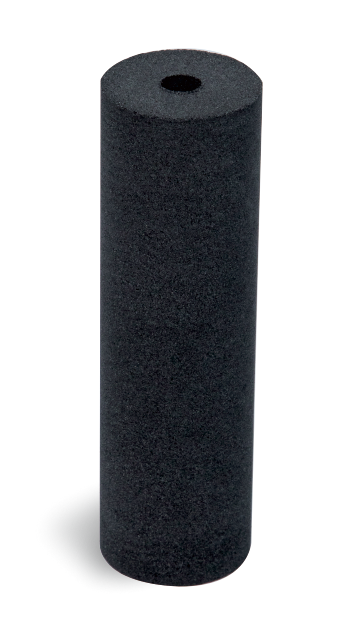
Celrith sintered activated carbon rod Ф60×240 is a coconut-shell carbon block filter that removes chlorine, odours, discolouration and heavy metals such as lead and mercury from drinking water. It is built for household reverse-osmosis purifiers (as a pre- or post-filter), direct-drinking dispensers, refrigerator water systems and commercial coffee machines. The rod combines high-iodine coconut-shell activated carbon with food-grade ion-exchange resin in a sintered structure, and Celrith supplies it in standard sizes or to custom dimensions.
Municipal water is not clean by the time it reaches a tap. Residual chlorine from disinfection gives water a chemical taste and smell; organic matter and VOCs add musty or plastic notes; rust and sediment from ageing pipes show up as discolouration and particles. In hard-water areas, calcium and magnesium scale builds up on heating elements and membranes. Heavy metals such as lead and mercury can also be present at low levels, and they are not removed by sediment filtration alone.
These contaminants do more than affect taste. Chlorine attacks the thin polyamide layer of RO membranes and shortens their service life. Scale increases pressure drop and reduces flow. Fine carbon dust from lower-quality blocks can migrate downstream and clog valves or post-filters. The result is more frequent cartridge changes, higher maintenance cost and water that still does not taste clean.
Every cartridge in a water system has a job, and when one underperforms, the next stage absorbs the load. A carbon block that releases fines forces the RO membrane or the post-filter to trap them, which raises differential pressure and lowers output. A block with weak adsorption capacity lets chlorine pass through, so the membrane oxidises faster and the final taste is still chlorinated. In hard water, an untreated stream deposits scale on heating coils and reduces the efficiency of coffee machines and dispensers.
The load is cumulative. A cartridge that only partially removes contaminants may appear to work at first, but the hidden cost shows up as shorter membrane life, more service calls and complaints about taste or white deposits. The practical fix is a filter that addresses several contaminant classes at once and holds onto what it captures.
Celrith sintered activated carbon rods are made from 100% premium coconut-shell carbon with a high iodine value, which gives a large internal surface area for adsorbing chlorine, odours and organic compounds. The carbon is combined with food-grade ion-exchange resin that softens the water and helps capture heavy metals such as lead and mercury. This dual function means one cartridge can reduce scale-forming hardness and taste-and-odour problems at the same time.
The sintering process creates a uniform microporous structure. The block has a high initial flow rate, so it does not throttle the system at start-up, and it has a high saturation capacity for a longer service life. The structure is designed not to shed black carbon fines downstream, which protects valves, membranes and post-filters. Mechanical filtration also captures sediment and rust particles, so the water passing through is clearer.
Celrith offers flexible forming for dimensions from Ф30 to Ф60 and custom lengths, with end-cap welding available. This means the rod can be matched to the housing and flow path of a specific purifier, dispenser or coffee machine rather than forcing a compromise on fit.
| Item | Detail |
|---|---|
| Product name | Carbon block water filter / CTO filter for water purifiers and refrigerators |
| Core filtration material | High-iodine coconut-shell activated carbon with food-grade ion-exchange resin |
| Core performance | Softens water and inhibits scale; adsorbs residual chlorine (bleaching powder); removes odours and discolouration; captures harmful heavy metals such as lead and mercury |
| Precision and service life | Uniform microporous structure, high initial flow, high filtration precision, no black carbon fines; large saturation capacity for long service life |
| Standard size references (outer diameter × length, mm) | Ф60×130 / Ф62×240 / Ф37.5×75 / Ф38×57 / Ф40×195 / Ф51×127 / Ф32×126 / Ф32×106 |
| Main applications | Household reverse-osmosis purifiers (pre-filter CTO or post-filter T33), direct-drinking dispensers, side-by-side refrigerator water filters, commercial coffee machines |
| Customisation | Full OEM/ODM support. Length, diameter and inner/outer diameter ratios can be tooled to the device; end-cap welding available |
| Quality systems | 20,000 m² production base certified to ISO 9001 and IATF 16949; filter media meet strict drinking-water safety and hygiene standards; CNAS-accredited testing centre for quality control |
This carbon rod is used by household reverse-osmosis purifier brands as a pre-filter (CTO) to protect the RO membrane from chlorine and sediment, or as a post-filter (T33) to polish taste. Direct-drinking dispensers and water coolers use it as the final barrier before the tap. Refrigerator manufacturers fit it into side-by-side models with built-in water dispensers, and commercial coffee-machine operators use it to protect boilers from scale and keep coffee flavour free of chlorine notes.
Because the rod can be customised in diameter, length and end-cap design, it also suits appliance OEMs that need a filter matched to a new housing, and water-treatment integrators that assemble multi-stage systems. The same carbon block can serve a compact under-sink unit or a larger commercial dispenser when the dimensions and flow path are specified.
Celrith products are manufactured under a quality and environmental management system that holds ISO 9001, ISO 14001 and ISO 45001 certification. The materials comply with REACH and RoHS requirements, and compliance documents can be provided for customer files. The production base was certified to IATF 16949 in 2024, reflecting automotive-level process control applied to filtration manufacturing.
Quality data is generated in a CNAS-accredited laboratory that can issue reports on filtration efficiency, dust-holding capacity and resistance. The plant covers 50,000 m², including six cleanrooms totalling 20,000 m², which helps keep the carbon rods free of secondary contamination during production. With more than 20 years of filtration experience and export to Europe, the United States, Japan and South Korea, Celrith supports OEM/ODM projects from dimension and structure to logo and packaging, and has developed over 1,000 filtration solutions.
To recommend the right Celrith carbon rod for your system, please share the device or vehicle model, the required size or a drawing, the airflow or water flow, the operating conditions (pressure, temperature, water quality) and the quantity you expect to order. With those details we can confirm the fit, propose a sample and prepare a quotation.
Contact Celrith to start the conversation.
The Celrith sintered activated carbon rod removes residual chlorine (bleaching powder), odours and discolouration, organic compounds and volatile organic chemicals through adsorption. Its built-in food-grade ion-exchange resin softens the water and captures heavy metals such as lead and mercury, while the sintered structure also intercepts sediment and rust particles. The result is cleaner-tasting water with reduced scale-forming potential.
By reducing chlorine and organic load before the water reaches the membrane, the carbon rod limits oxidation that shortens membrane life. Its structure is designed not to release black carbon fines, so valves and post-filters are not clogged by carbon dust. In hard water, the ion-exchange resin reduces scale that would otherwise build up on heating elements and membranes.
Yes. Celrith supports full OEM/ODM customisation, including outer diameter, length, inner/outer diameter ratio and end-cap welding. Standard sizes range from Ф30 to Ф60 in diameter, and custom tooling is available to match a specific housing or flow path. Share your drawing or sample and the target flow rate so we can confirm feasibility.
Samples are available for evaluation. Please provide your device model, required size or drawing, water flow and operating conditions so we can select the closest standard rod or propose a custom build. With those details we will send a quotation and sample lead time.
For the standard Ф60×240 carbon rod, the minimum order quantity is typically 1,000 to 2,000 pieces. Custom sizes may have a different MOQ depending on the complexity of the specification. Please confirm your target size and annual volume so we can give an exact figure.
Standard stock items usually ship within 7 to 15 days. OEM custom orders generally take 25 to 35 days, including tooling confirmation and sample approval. Lead times can vary with order quantity and specification, so please confirm with our team when placing your inquiry.
Replacement depends on water quality and daily volume, but a typical service interval for the Ф60×240 carbon rod is 6 to 12 months under standard flow conditions. If you notice a return of chlorine taste or reduced flow, it is time to change the cartridge. We can advise on a schedule based on your water analysis and usage.
Yes. The carbon and resin are food-grade and the filter media meet strict drinking-water safety and hygiene standards. Celrith holds ISO 9001, ISO 14001, ISO 45001 and IATF 16949 certification, and products comply with REACH and RoHS requirements. For market-specific approvals, please contact us with your destination country.