
EN

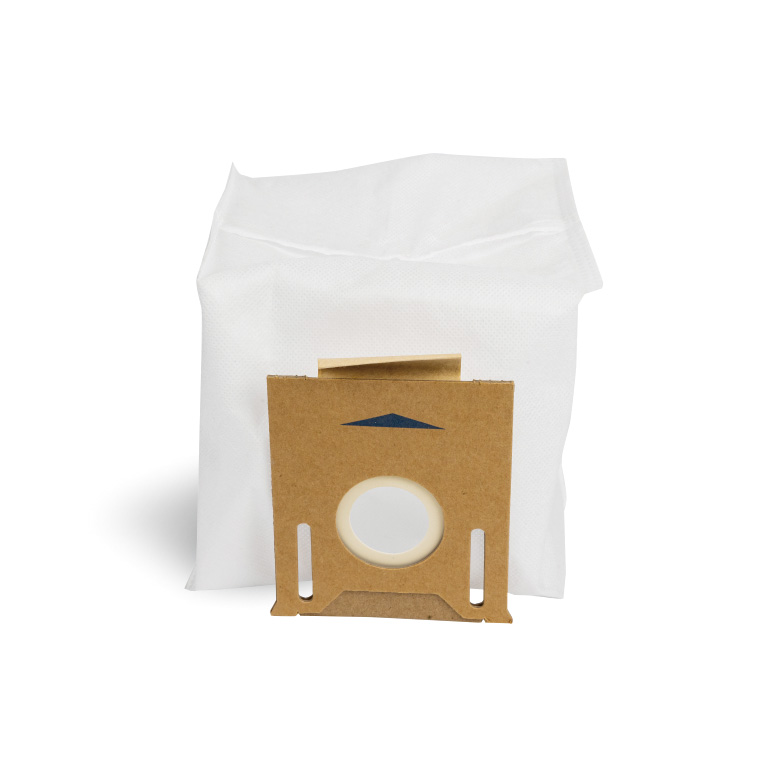
Celrith dust bags with a reversible paper cap are multi-layer composite PP meltblown filter bags made for robot vacuum auto-empty docks, cordless stick vacuums and commercial vacuum bins. They capture fine household dust including PM2.5, dust mites, pollen and hair at the exhaust stage, so particles are not blown back into the room. The bags are aimed at vacuum and appliance brands, OEM/ODM buyers and commercial cleaning suppliers who need a low-airflow-resistance bag that keeps suction strong and fits their own dock or bin design.
Every vacuum cycle picks up more than visible debris. A typical home load includes fine mineral dust, textile fibres, skin flakes, pet dander, pollen and dust mite waste. These particles are small enough to stay airborne for hours once they leave the floor, and the exhaust air of a vacuum or an auto-empty dock is the last point where they can be stopped.
Odour is the second load. Organic debris held in a bin or bag can develop a stale smell, especially in closed docks where air is recirculated. Waterborne impurities are not the target here, but damp debris and condensation in a bin can encourage microbial growth and worsen odour.
The consequence is simple: a bag with poor retention turns the vacuum into a particle distributor, and a bag with high airflow resistance forces the motor to work harder for the same pickup result.
Dust that passes through a bag does not disappear. It settles on the motor, fan blades, sensors and dock contacts. Over time this film of fine dust reduces cooling efficiency, raises motor temperature and can shorten the service life of the appliance. In an auto-empty dock, dust that escapes the bag can also contaminate the dock chamber and the charging contacts.
Airflow resistance is the other side of the load. A dense filter with high resistance protects the exhaust air but makes the motor strain to maintain suction, which increases energy use and noise. A bag that is too open protects the motor but releases fine dust. The design task is to hold particles while keeping resistance low enough that the motor runs within its normal working range.
Capacity matters as well. A bag that fills quickly forces frequent replacement, and each replacement is a chance for dust to spill. High dust-holding capacity with a reliable closure reduces handling and keeps the system stable between changes.
Celrith builds the bag from multi-layer high-precision composite PP material, combining polypropylene nonwoven with meltblown layers and an antibacterial filter cotton option. The layered structure traps fine dust and common household allergens at the exhaust stage, which limits secondary contamination of the room air.
The material is engineered for high porosity and low operating airflow resistance. That combination lets the bag hold a large dust load without choking the motor, so suction stays close to the level the appliance was designed to deliver. For odour-sensitive applications, a version with composite activated carbon is available.
Handling is addressed with a sliding handle and automatic sealing design. When the bag is removed, the opening closes so the user does not touch the collected dust. The cap format is customisable: hard paperboard caps and eco-friendly injection-moulded plastic caps are both available, and the bag can be built to the exact dimensions and interface of the target dock or bin.
Celrith supports full OEM customisation across size, cap structure, filter media grade and packaging, and has developed more than 1,000 filtration solutions. Because the bag is made to the device rather than adapted afterwards, fit and sealing are controlled at the design stage.
| Item | Detail |
|---|---|
| Product name | Dust bag for handheld vacuums and robot vacuum auto-empty docks |
| Core media construction | Multi-layer high-precision composite PP (polypropylene nonwoven plus meltblown) with antibacterial filter cotton material |
| Filtration function | High-precision interception of fine dust (PM2.5), dust mites, pollen, hair and similar household allergens; limits secondary exhaust contamination |
| Physical and flow characteristics | High-porosity breathable design, very low operating airflow resistance, high dust-holding capacity, does not drain motor suction |
| Main end applications | Robot vacuum auto-empty docks, cordless handheld vacuums, commercial vacuum bins |
| Size and cap customisation | Fully customised to device dimensions; hard paperboard caps and eco-friendly injection-moulded plastic caps; sliding automatic-seal and activated-carbon odour-control versions available |
| Company certification system | 50,000 m² modern clean production plant and a CNAS-accredited testing centre; ISO 9001, ISO 14001 and IATF 16949 quality management systems |
Robot vacuum brands use these bags in auto-empty docks, where the bag is the primary barrier between the collected dust and the room. Stick vacuum makers use them as the disposable collection stage for cordless models, and commercial cleaning suppliers fit them to vacuum bins in offices, hotels and retail spaces where dust and odour control matter during operation.
The common requirement across these users is fit. A dock has a fixed chamber, a fixed inlet and a fixed lid geometry, so the bag has to match the interface precisely. Celrith works from customer samples or 3D drawings to define dimensions, cap type and sealing behaviour, then produces the bag to that specification. Buyers who want a private-label line can also specify logo, packaging and media grade.
Celrith products meet REACH and RoHS environmental compliance requirements, and compliance documents can be supplied with orders. The company holds ISO 9001, ISO 14001 and ISO 45001 system certifications, and added IATF 16949 automotive quality management certification in 2024.
Testing is carried out in the company's own laboratory, which is CNAS-accredited and can issue reports on filtration efficiency, dust-holding capacity and airflow resistance. Production runs in a 50,000 m² plant that includes 6 cleanrooms totalling 20,000 m².
Quality control covers IQC, IPQC and OQC through the full process, and multiple automated production lines support monthly output in the millions of pieces. With more than 20 years of filtration development and manufacturing experience and continuous exports to Europe, the United States, Japan and South Korea, Celrith is based in Zhongshan, Guangdong, China.
To quote accurately, please send your device or vehicle model, the bag size or a drawing, the airflow your system runs at, the operating conditions (dust type, odour control needs, temperature) and the quantity you plan to order. If you are developing a new dock or bin, a 3D file or a physical sample is the fastest route to a matching design.
Contact Celrith with these details and our team will respond with a specification proposal and quotation.
The multi-layer composite PP and meltblown structure captures fine dust including PM2.5, dust mites, pollen, hair and similar household allergens at the exhaust stage. This limits secondary contamination of room air when the vacuum or auto-empty dock runs. An activated-carbon version is available where odour control is also required.
The media is built for high porosity and very low operating airflow resistance, so the motor is not forced to work against a dense barrier. Combined with high dust-holding capacity, the bag keeps airflow close to the appliance's design level between changes. The result is strong pickup without releasing the fine fraction.
Yes. Celrith customises size, cap structure and interface to the target device, using hard paperboard caps or eco-friendly injection-moulded plastic caps. Sliding automatic-seal and activated-carbon odour-control versions can also be specified. Customers normally provide a sample or 3D drawing so the fit and sealing are defined before production.
Sample arrangements and pricing are confirmed against your specification, so send the device model, size or drawing, airflow and expected quantity with your request. The team will then propose a specification and quotation. Testing data from the CNAS-accredited laboratory can support your evaluation.
MOQ depends on the specification, particularly the cap type, media grade and packaging. Standard configurations and fully custom designs are quoted separately. Share your target volume through the contact page and Celrith will confirm the MOQ for your configuration.
Lead time is confirmed with the order because it depends on whether the bag is a standard configuration or a new custom design requiring tooling. Providing complete drawings and quantity early helps shorten the confirmation stage. The production base runs multiple automated lines with monthly output in the millions of pieces.
Replacement should follow the appliance manufacturer's indicator or the bag's fill level, since a full bag raises airflow resistance and reduces suction. The high dust-holding capacity means fewer changes than a low-capacity bag, and the sliding automatic seal keeps dust contained at each change. Replace before the bag is packed tight to protect motor performance.
Celrith produces bags to fit robot vacuum auto-empty docks, cordless handheld vacuums and commercial vacuum bins, and can build them compatible with the dock geometry of the brands you specify. Because each design is made to the device dimensions, compatibility is confirmed from your sample or drawing rather than assumed. Send your model details through the contact page to start the fit check.