
EN

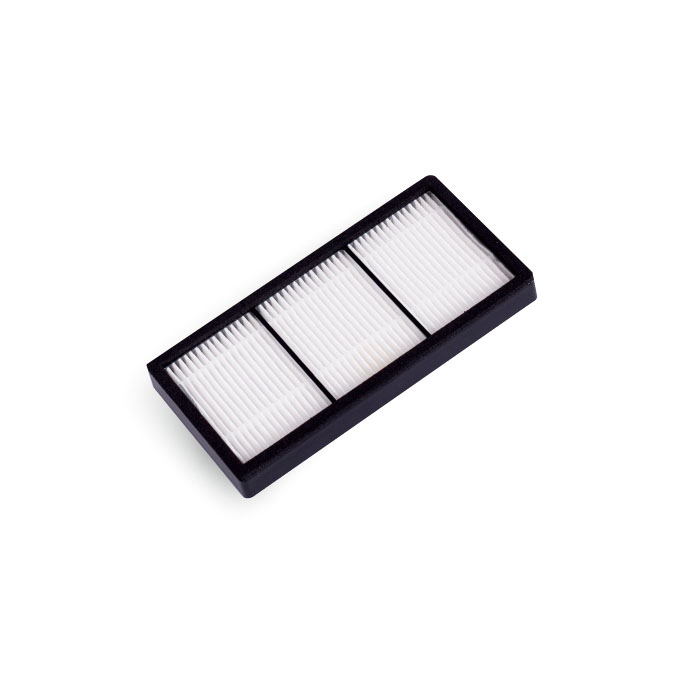
The Celrith Dust Box HEPA Filter is a replacement filter for robot vacuums and handheld vacuums that captures fine dust, PM2.5, dust mites, pollen and pet dander before it can be recirculated into the room. It is designed for appliance makers, vacuum brands and aftermarket suppliers who need a washable, low-resistance filter that protects suction and battery runtime. Celrith manufactures this filter with PTFE membrane or composite PP meltblown media and customises it to fit specific dust box dimensions.
Every vacuum cleaning cycle lifts a mixture of coarse debris and microscopic particles. The coarse fraction is visible; the fine fraction is not. Particles in the PM2.5 range, dust mite fragments, pollen and pet dander can remain airborne long enough to be inhaled or to settle on surfaces shortly after the vacuum stops. When a dust box filter is overloaded or poorly sealed, these particles bypass the media and are exhausted back into the room, a effect known as secondary contamination.
The contaminant load varies by environment. Homes with pets generate more dander and hair; bedrooms carry dust mite allergens; pollen seasons raise the fine particle count; and handheld vacuums used on mattresses and car interiors face concentrated dust and mite debris. In each case, the filter is the barrier between the collected dirt and the air the user breathes. A filter that captures fine particles but restricts airflow forces the motor to work harder, while a filter that is too open lets contaminants pass through. The Celrith filter is built to balance these two demands.
Restriction is the hidden cost of filtration. As a filter loads with dust, its resistance rises and the motor must compensate. In battery-powered vacuums, that compensation draws more current and shortens runtime. In robot vacuums, reduced airflow can leave fine dust in the dust box and on the pre-filter, increasing the frequency of manual cleaning. A high-resistance filter can also cause the vacuum to signal a full bin prematurely, interrupting a cleaning cycle.
Moisture and organic debris add another layer of load. Humid environments and wet pickup can encourage microbial growth on filter media, which leads to odour and degradation. Filters that are not washable must be replaced frequently, adding consumable cost and waste. The Celrith filter addresses these loads through a high-porosity breathable structure that keeps operating resistance low, and through moisture-resistant, antibacterial media options that support washing and reuse.
Celrith uses high-precision PTFE microporous membrane or composite PP meltblown media. The PTFE membrane provides efficient fine-particle capture with a low pressure drop, while the composite PP structure offers high dust-holding capacity and resistance to moisture. Both options are available in washable configurations, allowing the filter to be cleaned and reused according to the appliance maker's instructions.
The filter frame is injection-moulded in eco-friendly plastic and can be edge-sealed to the media to prevent bypass. Because dust box geometries differ across robot vacuum, handheld vacuum, mattress vacuum and car vacuum platforms, Celrith customises the outer dimensions, frame shape and sealing to the customer's dust box. This is a made-to-fit component, not a one-size-fits-all consumable.
For brands that require washable filters, the PTFE-coated version supports large-scale OEM production. The low-resistance design helps preserve motor suction and battery runtime, so the appliance performs as specified even as the filter captures fine contaminants. Celrith's engineering team can review a drawing or sample and propose a filter structure that matches the available space and target efficiency class.
| Item | Detail |
|---|---|
| Product name | Robot Vacuum Cleaner / Handheld Vacuum Filter (Dust Box HEPA Filter) |
| Core filtration media | High-precision PTFE (polytetrafluoroethylene microporous membrane) / composite PP (polypropylene meltblown) and other moisture-resistant, antibacterial filter materials |
| Core purification function | Strong interception of PM2.5, fine dust, dust mites, pollen and pet dander inside the vacuum; prevents secondary contamination from exhaust air |
| Physical fluid characteristics | High-porosity breathable design with very low operating resistance; does not drain motor suction and helps improve device battery runtime |
| Main end applications | Smart robot vacuums, handheld cordless vacuums, mattress mite-removal vacuums, car mini vacuums, wet-dry floor cleaners |
| Frame and size customisation | 100% customised to the device dust box dimensions. Eco-friendly injection-moulded frame, edge rubber sealing, and scaled OEM production of washable PTFE-coated versions |
| Company certification system | 50,000 m² modern production base and a national-level CNAS testing centre. The company operates under ISO 9001, ISO 14001 and IATF 16949 international quality management system standards. |
This filter is used by appliance brands and aftermarket suppliers serving several vacuum categories. Robot vacuum makers specify it for dust box filtration where space is limited and airflow must remain stable. Handheld cordless vacuum brands use it to protect motor and battery performance while capturing fine dust. Mattress vacuum and mite-removal device makers rely on its fine-particle capture for bedding applications. Car vacuum and wet-dry floor cleaner producers use it where moisture resistance and washability matter.
The filter is compatible with major robot vacuum and handheld vacuum platforms, including structures used by iRobot, Xiaomi, Roborock, Ecovacs and Dyson. Compatibility here means the filter can be customised to fit those dust boxes; it does not imply that Celrith is affiliated with or endorsed by those brands. OEM and ODM customers can specify filter grade, frame material, colour, logo and packaging.
Celrith manufactures in Zhongshan, Guangdong, China, in a 50,000 m² production base that includes six cleanrooms totalling 20,000 m². Production in a controlled environment helps prevent secondary contamination during manufacturing. The company holds ISO 9001, ISO 14001 and ISO 45001 system certifications, and in 2024 obtained IATF 16949 automotive quality management certification. Products comply with REACH and RoHS environmental regulations, and compliance documents can be provided.
Testing is carried out in the company's own laboratory, which is accredited by CNAS (China National Accreditation Service for Conformity Assessment) and can issue reports on filtration efficiency, dust-holding capacity and resistance. Quality control follows IQC, IPQC and OQC stages. Celrith has more than 20 years of experience in filter development and manufacturing, exports to Europe, the United States, Japan and Korea, and has developed over 1,000 filtration solutions. Multiple automated production lines support monthly capacity in the millions of pieces.
To receive a quotation or a custom filter proposal, please share the following with our team: the device or vehicle model, the dust box size or a drawing, the target airflow or suction requirement, the operating conditions (including moisture exposure and washability), and the estimated order quantity. With these details, Celrith can confirm filter grade, frame design and sampling schedule. Contact us to start the conversation.
It captures PM2.5, fine dust, dust mites, pollen and pet dander from the air passing through the vacuum's dust box. This prevents secondary contamination from exhaust air. The media options include PTFE membrane and composite PP meltblown.
The filter is available in H11 to H13 grades, corresponding to ≥95% to ≥99.97% filtration efficiency for 0.3 μm particles. The exact grade is selected according to the appliance's target performance and the customer's market requirements. CNAS-accredited laboratory testing can verify efficiency, resistance and dust-holding capacity.
Yes. Celrith customises the outer dimensions, frame shape and edge sealing to the customer's dust box, using a drawing or sample for a 1:1 match. Frame material, colour, logo and packaging can also be specified. This is a made-to-fit component rather than a universal consumable.
Washable versions can be rinsed according to the appliance maker's instructions; replacement intervals depend on use and dust load, so the appliance manual should be followed. Non-washable versions should be replaced when airflow drops noticeably or the vacuum signals a full bin. Celrith can advise on a suitable maintenance schedule for each application.
For standard models, 1–3 samples can be provided free of charge with freight collect; custom samples may incur a sampling fee that is credited against a bulk order. Standard sampling takes 3–7 working days, while tooling-based custom samples take about 10–15 working days. Quotations are issued after the device model, size or drawing, airflow requirement and quantity are confirmed.
MOQ for standard specifications is typically 5,000–10,000 pieces, while custom products are negotiated according to specification complexity. Celrith can discuss first-order quantities flexibly for market introduction. Bulk orders are supported by multiple automated production lines with monthly capacity in the millions of pieces.
In-stock standard orders ship in about 7–15 days. Customised orders, including tooling, typically take 30–45 days from order confirmation. Lead times are confirmed at the time of order and depend on specification and quantity.
Yes. The filter materials comply with REACH and RoHS environmental regulations, and Celrith can provide compliance documents. The company operates under ISO 9001, ISO 14001 and ISO 45001 certifications, and obtained IATF 16949 certification in 2024. Contact us with your target market requirements to confirm the applicable documentation.