
EN

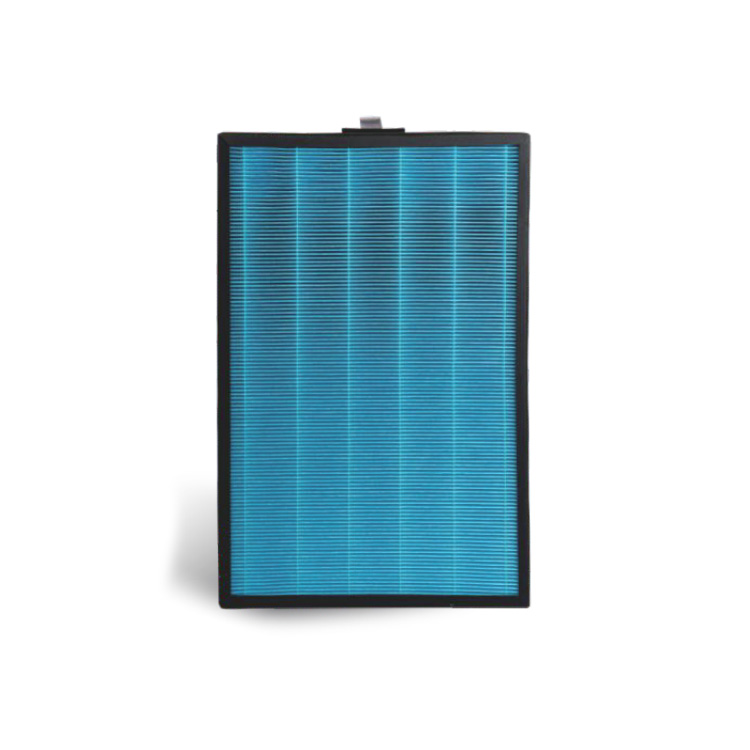
The Celrith Flat Panel HEPA Filter (MAX Series) is a low-profile panel filter that removes sub-micron particles from the air, with media options ranging from PP and PP+PET composite to PTFE membrane. It is built for household and commercial air purifiers, desktop mini purifiers, humidifier-purifier combinations, dehumidifiers and robot vacuum exhaust outlets. Celrith supplies it as a flat panel engineered around your device drawing, so the filter fits the space your product actually has.
Airborne sub-micron particles are the hardest fraction to catch. They stay suspended for hours, pass through coarse screens and standard foam or mesh pre-filters, and settle where airflow slows — on heat exchangers, fans, sensors and internal surfaces. For a purifier or dehumidifier, that means the appliance keeps working against a load it was never designed to carry.
The contaminant load does not arrive alone. Dust, pollen, smoke and fine particulate matter come with odour and gaseous impurities that a particle filter alone will not address. A flat panel HEPA stage is the particle barrier in a multi-stage train: the pre-filter takes the coarse fraction, the HEPA panel takes the sub-micron fraction, and any carbon or gas stage handles odour. The cleaner the particle stage runs, the longer the equipment behind it performs as specified.
Particles are not only an air-quality issue; they are a mechanical and thermal one. Deposits on a fan blade change its balance and airflow. Deposits on a coil or heat exchanger reduce heat transfer and raise energy draw. Deposits on sensors produce false readings, and the control system then runs the device at the wrong speed. In compact appliances — desktop purifiers, robot vacuum exhausts, combination humidifier units — the available filtration space is small, so a bulky filter is not an option, and a filter with high resistance makes the fan work harder and louder.
This is the trade-off most panel filters fail: plenty of media in a thick frame, or a thin frame with too little media and a short service life. The MAX flat design addresses both sides. Its low-profile structure frees core design space inside the appliance, while the pleated media is selected and arranged to keep initial resistance low and dust holding capacity high. Low resistance means less load on the fan and motor; high dust holding capacity means the filter stays in service longer before replacement.
The MAX Series is built around three media families. PP (polypropylene melt-blown) is the standard choice for cost-effective particle capture. PP+PET composite is a moisture-resistant option suited to humidifier-purifier combinations, dehumidifiers and other wet-adjacent air paths. PTFE membrane is available where the application needs the highest particle capture from the thinnest media. The filtration grade follows the media selected, spanning sub-high-efficiency (E11) through ultra-high-efficiency (H14/U15).
Two design decisions shape the performance. First, the flat panel geometry: the MAX profile is a flat, space-efficient format that fits where a deep pleated cartridge will not. Second, the pleat and media selection: the panel is configured for low initial resistance while retaining a large dust load, which extends consumable life. Celrith does not sell a fixed catalogue size where a drawing exists — the panel is made to your dimensions, thickness and sealing process, in 100% OEM/ODM flexible customisation.
For appliance makers, the practical result is a filter that can be designed into the chassis from the start rather than squeezed in afterwards. For brand owners sourcing replacement filters, it means a panel that matches the original fit and keeps airflow within the device's design envelope.
| Item | Detail |
|---|---|
| Product name | Flat Panel HEPA Filter (MAX Series) |
| Physical structure | MAX flat-profile design; low air resistance; high space utilisation |
| Core filtration media | PP (polypropylene melt-blown) / PP+PET composite moisture-resistant material / PTFE membrane |
| Filtration performance | From sub-high efficiency (E11) to ultra-high efficiency (H14/U15); efficiency depends entirely on the media grade selected |
| Resistance and dust holding | Low initial resistance through fluid-dynamic optimisation, while maintaining high dust holding capacity to extend consumable service life |
| Main end applications | Household/commercial air purifiers, desktop mini purifiers, humidifier-purifier combinations, dehumidifiers, robot vacuum exhaust outlets |
| Size and specification customisation | 100% OEM/ODM flexible customisation; any length, width, thickness and sealing process built to the customer's complete device drawing |
| Quality certification systems | Production certified to ISO 9001/14001 and IATF 16949; CNAS-accredited testing centre; outgoing control of resistance, leak testing and efficiency indicators |
The MAX Series is used by appliance manufacturers and brand owners who need a thin HEPA stage inside a compact product. Typical users include air purifier makers for household and commercial units, designers of desktop mini purifiers, humidifier-purifier combination brands, dehumidifier manufacturers, and robot vacuum producers who need filtration at the exhaust outlet.
It also suits OEM/ODM buyers who want one panel platform across several device models, with media grade adjusted per model rather than a new tooling project each time. Where a product line needs a moisture-resistant filter for a wet air path, the PP+PET composite option covers it; where the priority is maximum capture from minimum media thickness, PTFE is available.
Celrith's products meet REACH and RoHS environmental compliance requirements, and compliance documentation can be supplied. The company holds ISO 9001, ISO 14001 and ISO 45001 system certifications and added IATF 16949 automotive quality management certification in 2024.
Testing is carried out in the company's own CNAS-accredited laboratory, which can issue reports on filtration efficiency, dust holding capacity and resistance. Production runs in a 50,000 m² plant, including 6 cleanrooms totalling 20,000 m², with IQC, IPQC and OQC controls across the process. Celrith has more than 20 years of filtration product development and manufacturing experience, has exported to Europe, the United States, Japan and Korea for over 20 years, and has developed more than 1,000 filtration solutions. The company is located in Zhongshan, Guangdong, China.
To quote the MAX Series accurately, send us the device or vehicle model, the required size or a drawing, the airflow or water flow the filter must handle, the operating conditions, and your quantity. With those details we can confirm media grade, panel dimensions and project timeline. Start the conversation through our contact page.
It captures sub-micron airborne particles, with the grade depending on the media selected — from sub-high efficiency (E11) to ultra-high efficiency (H14/U15). Particle capture is handled by the PP, PP+PET composite or PTFE media; odour and gaseous impurities are addressed by a separate gas stage in the system. It is a particle barrier, not a combined particle-and-gas filter.
Efficiency depends entirely on the media grade selected, spanning E11 through H14/U15. Typical applications are household and commercial air purifiers, desktop mini purifiers, humidifier-purifier combinations, dehumidifiers and robot vacuum exhaust outlets. Tell us the target grade and device and we will match the media.
Yes. The MAX Series supports 100% OEM/ODM flexible customisation: length, width, thickness and sealing process are built to your complete device drawing, and media grade is chosen per model. Celrith has developed more than 1,000 filtration solutions, which helps shorten the fit-and-performance discussion. Share a drawing and we will confirm feasibility.
Send the device or vehicle model, size or drawing, airflow or water flow, operating conditions and quantity through our contact page, and we will respond with a quotation. Sample policy and lead times are confirmed per project once those details are known. Providing a drawing at the start keeps both the sample and the quote accurate.
MOQ is set per project and depends on panel size, media grade and structure, so it is confirmed with your quotation rather than fixed in advance. Because the panel is made to your drawing, the quantity discussion follows the size and media decision. Include your expected volume in the inquiry for a precise answer.
Replacement is driven by dust loading and operating conditions, not by a single fixed interval, so the correct approach is to size the panel to the device's expected life and monitor resistance. The low-resistance, high-dust-holding design extends service life between changes. We confirm the expected replacement basis for your application during the project.
Celrith products meet REACH and RoHS environmental compliance requirements and compliance files can be provided. Production is certified to ISO 9001, ISO 14001 and IATF 16949, and the company's CNAS-accredited laboratory can issue reports on efficiency, dust holding capacity and resistance. These documents support your own market entry and brand claims.
Lead time is confirmed per project once the drawing, media grade and quantity are fixed, and it is stated in your quotation. Because each panel is built to the customer's device drawing, the schedule depends on those inputs. Send your requirements through the contact page and we will set out the timeline with the quote.