
EN

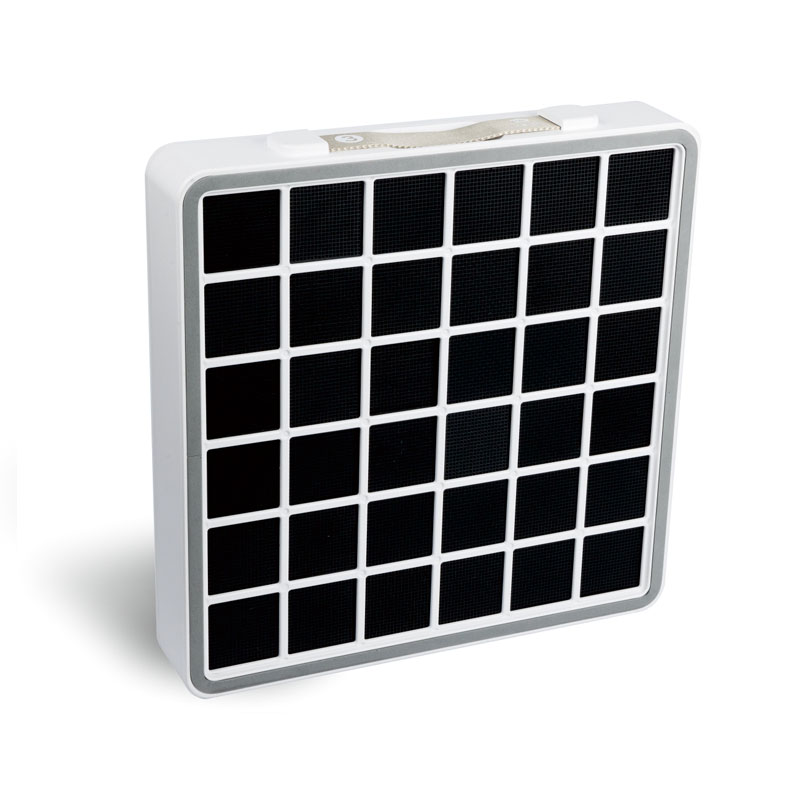
Celrith honeycomb activated carbon filters are designed to capture formaldehyde, benzene, ammonia, TVOCs and stubborn odours from the air passing through air purifiers, HVAC systems and vehicle cabins. The plastic honeycomb framework holds high-iodine-value carbon in a low-resistance structure, making it suitable for residential and commercial air treatment equipment. This filter is aimed at OEM and ODM customers who need reliable gas-phase filtration with flexible sizing.
Volatile organic compounds (VOCs) such as formaldehyde, benzene and ammonia are common indoor air pollutants. They originate from building materials, furniture, cleaning agents and combustion processes, and can cause discomfort and health concerns at elevated concentrations. Odours from cooking, pets and waste are also persistent and difficult to remove with particle filtration alone. These gaseous contaminants require adsorption media with high surface area and residence time to be effectively captured.
When gas-phase contaminants are not adequately removed, they can accumulate in ductwork, heat exchangers and occupied spaces, leading to complaints and reduced perceived air quality. In air purifiers and HVAC systems, loaded carbon filters can increase pressure drop over time, forcing fans to work harder and raising energy consumption. In vehicle cabins, odours and exhaust gases can enter through the ventilation system, affecting driver and passenger comfort. A well-matched carbon filter reduces this load by providing a dedicated adsorption stage with minimal airflow resistance.
Celrith honeycomb activated carbon filters use a high-strength, moisture-resistant engineering plastic honeycomb framework filled with high-iodine-value granular activated carbon or a catalyst-modified formaldehyde removal carbon combination. The honeycomb structure offers extremely high porosity, allowing air to pass through smoothly with very low resistance, which helps maintain airflow and reduce fan energy demand. The plastic framework is moisture-proof, mould-resistant and corrosion-resistant, and it will not collapse under normal operating conditions. This design ensures a long service life and stable performance even in humid environments.
The carbon media is selected for its adsorption capacity, effectively capturing formaldehyde (HCHO), benzene, ammonia, TVOCs and various odours. The combination of low airflow resistance and high contact area allows the filter to deliver strong gas removal while maintaining system efficiency. For applications requiring enhanced formaldehyde removal, a catalyst-modified carbon can be specified.
| Item | Detail |
|---|---|
| Product name | Honeycomb Activated Carbon Filter – Plastic Honeycomb Type |
| Framework material | High-strength, moisture-resistant engineering plastic (plastic honeycomb framework) |
| Core media | High-iodine-value granular activated carbon / catalyst-modified formaldehyde removal carbon combination |
| Target contaminants | Formaldehyde (HCHO), benzene, ammonia, TVOCs and various stubborn odours |
| Structural advantages | Very high porosity, smooth airflow, extremely low resistance, moisture-proof, mould-resistant, corrosion-resistant, will not collapse |
| Typical applications | Residential/commercial air purifiers, fresh air ventilation systems, vehicle air conditioning filters, central air handling return-air odour removal |
| Customisation | 100% OEM flexible custom manufacturing: outer dimensions, thickness, honeycomb pore size and carbon loading weight can be precisely tooled to drawing requirements |
| Quality certification | Produced in a 50,000 m² plant; company certified to ISO 9001, ISO 14001 and IATF 16949 (automotive quality management system) |
Celrith honeycomb activated carbon filters are used by manufacturers of residential and commercial air purifiers, fresh air ventilation systems, vehicle air conditioning units and central air handling systems that require odour and gas removal. OEM and ODM customers integrate these filters into their products to meet indoor air quality standards and improve user comfort. The flexible customisation options make it suitable for both standard and specialised equipment designs.
Celrith operates a 50,000 m² manufacturing facility in Zhongshan, Guangdong, China, including 20,000 m² of cleanrooms across six workshops. The company holds ISO 9001, ISO 14001 and ISO 45001 certifications and was awarded IATF 16949 in 2024. Products comply with REACH and RoHS environmental regulations, and compliance documentation is available upon request. The on-site laboratory is CNAS-accredited and can provide test reports for filtration efficiency, dust holding capacity and resistance. With over 20 years of experience in filtration research and manufacturing, Celrith has exported to Europe, the United States, Japan and South Korea for more than two decades, and has developed over 1,000 filtration solutions. Multiple automated production lines support monthly output of millions of pieces, and quality control covers IQC, IPQC and OQC.
To receive a tailored quotation or to discuss your filtration requirements, please provide the following information: your device or vehicle model, required dimensions or a drawing, airflow rate or water flow (if applicable), operating conditions (temperature, humidity, contaminant concentration), and estimated quantity. Our team will respond promptly with a proposal. Contact us to start the conversation.
It adsorbs formaldehyde (HCHO), benzene, ammonia, TVOCs and various stubborn odours from the air. The high-iodine-value carbon media provides a large surface area for capturing these gases. For enhanced formaldehyde removal, a catalyst-modified carbon option is available. This makes it suitable for improving indoor air quality in air purifiers, HVAC systems and vehicle cabins.
The filter uses high-iodine-value coconut shell activated carbon and achieves a removal efficiency of over 85% for common TVOC pollutants such as toluene, benzene and xylene under standard test conditions. Actual performance depends on airflow, contaminant concentration and filter size. We can provide test data from our CNAS-accredited laboratory to support your specific application.
Yes, we offer full OEM/ODM customisation. You can specify dimensions, thickness, honeycomb pore size, carbon type (coconut shell, coal-based or modified), frame material (paper, plastic or aluminium), carbon loading weight and functional combinations such as HEPA plus activated carbon. We also provide logo printing and custom packaging. Simply provide your drawing or specifications, and we will tool the filter to match.
For standard models, the MOQ is typically 1,000–2,000 pieces. Customised models have a negotiated MOQ based on complexity. Standard lead time is 25–35 days, while repeat orders ship in 15–20 days. Our 50,000 m² facility supports large volumes and we have been supplying international customers for over 20 years.
Under typical residential air conditioner use (8 hours per day), the effective service life is 6–12 months, depending on TVOC concentration, temperature, humidity and airflow. Our CNAS-accredited test centre can provide life testing reports based on your operating conditions to help you set a replacement schedule. Regular replacement ensures consistent adsorption capacity and low pressure drop.
Yes, we welcome sample requests. Standard samples ship within 3–5 working days, while custom samples take 7–15 working days depending on design complexity. Each sample includes a test report from our CNAS laboratory. For B2B customers with confirmed projects, sample costs can be credited against future orders.
The filter is produced in a facility certified to ISO 9001, ISO 14001 and IATF 16949 (2024). Products comply with REACH and RoHS regulations, and compliance documents are available. Our laboratory is CNAS-accredited, and we can provide test reports for filtration efficiency, dust holding capacity and resistance. These credentials support market access and customs clearance in Europe, the US, Japan and South Korea.
The plastic honeycomb framework has very high porosity, creating smooth airflow with extremely low resistance. This reduces the load on fans and helps lower energy consumption while maintaining effective gas adsorption. The moisture-resistant plastic will not collapse or degrade, ensuring stable performance over time. For specific pressure drop data, please contact us with your operating conditions.