
EN

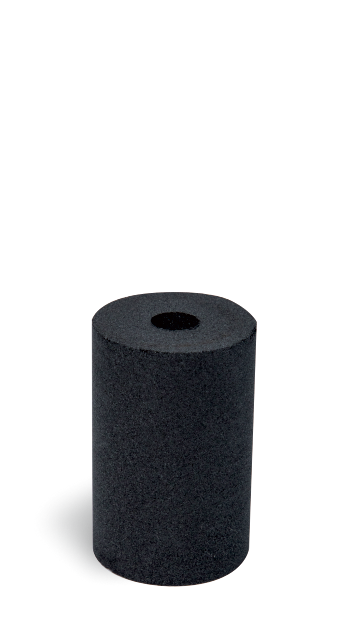
Celrith's Ф38×57 sintered activated carbon rod is a coconut-shell carbon block water filter that removes residual chlorine, colour, odour, VOCs and harmful heavy metals such as lead and mercury from drinking water, while its built-in food-grade ion exchange resin softens the water and helps prevent scale. The carbon block is made by sintering high-iodine-value coconut shell carbon with a food-grade binder, producing a uniform pore structure with high adsorption capacity and no black carbon fines. It is intended for household and commercial point-of-use water treatment, from RO pre/post filters and water dispensers to double-door refrigerators and commercial coffee machines. This page explains the contaminants it targets, the load they place on your equipment, and how Celrith's sintered carbon rod relieves it.
Waterborne impurities are not a single problem. They are a group of problems with different behaviours in water and on equipment surfaces, and each one stresses a different part of a treatment system.
The result is that a filter must do more than one job at once. It has to adsorb, exchange and intercept without letting fine carbon particles escape into the treated water.
When these contaminants are not addressed upstream, the load migrates to the system. Chlorine attacks RO membranes and shortens effective service life. Scale narrows flow paths in heating elements and coffee machine boilers, raising energy consumption and maintenance frequency. Fine particles foul membrane surfaces and clog valves and small orifices. Odour and taste complaints arrive at the consumer even when the system is technically functioning.
The cost is cumulative: more frequent membrane replacement, more service calls, more descaling downtime, and a less consistent drinking experience. A filter that removes the contaminant load early in the chain protects everything downstream of it.
The Celrith sintered activated carbon rod combines high-iodine-value coconut shell carbon with food-grade ion exchange resin in one sintered body. The carbon delivers efficient adsorption of residual chlorine (bleach), odour and colour, while the ion exchange resin softens the water and helps remove harmful heavy metals. The sintering process gives the rod a uniform microporous structure with high initial flow, high filtration precision, and no black carbon powder shedding into the treated water — a common issue with loose carbon media.
Because the rod is formed through a fully flexible moulding process, Celrith can customise diameter, length and the ratio of inner to outer diameter to fit a specific housing. Sizes from Ф30 to Ф60 are available, and end-cap welding can be customised. This means the filter can be matched to the flow and pressure characteristics of the device rather than forcing the device to accept a standard size.
The result is a clear contrast with the untreated case: chlorine and odour are adsorbed instead of passing through, scale-forming ions are exchanged instead of depositing on heating surfaces, and carbon fines are bound in the sintered matrix instead of reaching the downstream membrane or the cup.
| Item | Detail |
|---|---|
| Product name | Carbon block water filter for water purifiers and refrigerators (CTO filter) |
| Core filter media | High-iodine-value coconut shell carbon plus food-grade ion exchange resin |
| Core performance | Softens water and helps prevent scaling; adsorbs residual chlorine (bleach) and odour; removes colour and off-taste; intercepts harmful heavy metals such as lead and mercury |
| Filtration precision and service life | Uniform micropore structure, high initial flow, high filtration precision, no black carbon powder shedding; large adsorption capacity and long service life |
| Common size references (outer diameter × length, mm) | Ф60×130 / Ф62×240 / Ф37.5×75 / Ф38×57 / Ф40×195 / Ф51×127 / Ф32×126 / Ф32×106 |
| Main end applications | Household RO purifier pre-filter (CTO) and post-filter (T33); direct drinking water dispensers; built-in refrigerator water filters; commercial coffee machines |
| Customisation service | OEM/ODM supported; length, diameter and inner/outer diameter ratio can be tooled to the device; end-cap welding customisation available |
| Quality certification | 20,000 m² production site certified to ISO 9001 and IATF 16949; filter media conform to drinking-water safety and hygiene standards; CNAS-accredited laboratory quality control |
The Ф38×57 format and the broader Ф30–Ф60 size range suit manufacturers and brands that build filtration into their own products. Typical users include:
Because the rod can be tooled to a specific diameter, length and end-cap configuration, it is also suitable for appliances and systems that do not accept standard filter cartridges.
Celrith's products comply with REACH and RoHS environmental regulations, and compliance documentation can be provided with orders. The company holds ISO 9001, ISO 14001 and ISO 45001 system certifications, and its production site was certified to IATF 16949 in 2024.
Filter performance is checked in the company's own laboratory, which is accredited by CNAS (China National Accreditation Service for Conformity Assessment) and can issue test reports for filtration efficiency, dust holding capacity and resistance. Manufacturing takes place in a 50,000 m² plant in Zhongshan, Guangdong, China, which includes 6 cleanrooms totalling 20,000 m². Quality control runs through IQC, IPQC and OQC at incoming, in-process and outgoing stages.
With more than 20 years of filtration product development and manufacturing experience and more than 20 years of continuous export to Europe, the United States, Japan and South Korea, Celrith has developed over 1,000 filtration solutions and supports OEM/ODM customisation of size, structure, media grade, end caps, logo and packaging. Multiple automated production lines support monthly output in the millions of pieces.
To receive a quotation and a suitable recommendation, please tell us:
Send these details through our contact page and our team will respond with specifications, samples and pricing.
It adsorbs residual chlorine (bleach), odour, colour and organic contaminants such as VOCs, and it intercepts harmful heavy metals including lead and mercury. Its built-in food-grade ion exchange resin also softens the water and helps prevent scale. The sintered structure binds the carbon so no black powder sheds into the treated water.
Celrith's sintered carbon rod is designed for effective residual chlorine removal; the chlorine removal rate is stated at ≥90%. Actual performance depends on inlet chlorine concentration, flow rate and water quality, so we recommend confirming the target with your own test conditions. Test reports can be issued by the company's CNAS-accredited laboratory.
Yes. The rod is made by a fully flexible moulding process, so outer diameter, length and the inner/outer diameter ratio can be tooled to your device, and end-cap welding can also be customised. Standard sizes range from Ф30 to Ф60, with Ф38×57 only one of the common references. OEM/ODM projects are supported.
Yes. We welcome testing before cooperation, and standard specifications can be sampled for evaluation; custom sizes are quoted after we review your drawing or requirements. Please send your device model, required size or drawing, water flow and operating conditions through the contact page so we can prepare an accurate quotation.
The MOQ for standard sintered carbon rods is typically 1,000–2,000 pieces, depending on specification and packaging; custom models are suggested from 5,000 pieces. Standard items can ship in about 7–15 days, while OEM custom orders generally take 25–35 days for mass production. Scheduling is flexible because production runs in our own Zhongshan plant.
Under standard conditions (inlet residual chlorine ≤2 ppm, flow 1 L/min), the Ф38×57 rod has an effective life of approximately 3,000–6,000 litres or 6–12 months, depending on actual water quality and usage frequency. Replace it when flow drops noticeably or taste and odour return. Unopened original packaging has a shelf life of 2 years when stored cool, dry and away from odour sources.
Products comply with REACH and RoHS, and compliance documents can be supplied with orders. The production site holds ISO 9001, ISO 14001, ISO 45001 and, since 2024, IATF 16949 certification. The CNAS-accredited laboratory can issue reports on filtration efficiency, dust holding capacity and resistance to support your market registration.
It is commonly used as a pre-filter (CTO) or post-filter (T33) in household RO purifiers, in direct drinking water dispensers and refrigerators, and in commercial coffee machines. If your housing needs a different diameter or length, the same carbon and resin formulation can be produced in a custom size. Contact us with your device details to confirm the fit.