
EN

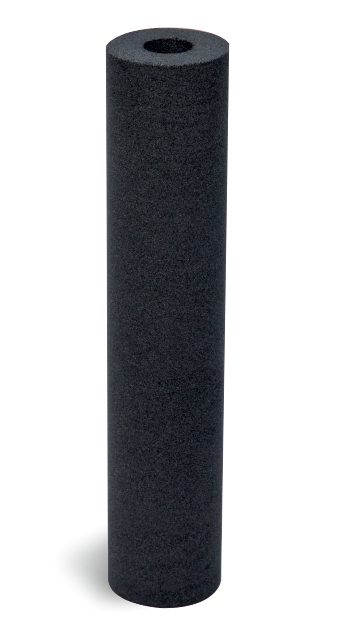
The Celrith sintered activated carbon block cartridge Ф40×195 is a coconut-shell carbon filter stick with built-in ion exchange resin, made for water purifiers, refrigerators and commercial coffee machines. It filters residual chlorine, odours, colour, and harmful heavy metals such as lead and mercury, while the resin softens the water to reduce scale. It is aimed at appliance brands, purifier OEMs and distributors who need a CTO or T33-style cartridge in a defined size or a custom drawing.
Municipal water arrives with a treatment signature: free chlorine and chloramine from disinfection, dissolved organic compounds, occasional colour and earthy odours, and trace heavy metals picked up along the distribution network. In hard-water areas, calcium and magnesium add a second burden that shows up as scale on heating elements, membranes and valves.
Inside the appliance this matters in practical terms. Chlorine is aggressive to thin polymer parts and rubber seals, and it carries a taste and smell that users notice immediately in drinking water and coffee. Dissolved organics and colour undermine clarity. Heavy metals are a safety concern that end users increasingly check on the label. And hardness is the slow problem: it does not show up on day one, but it shortens the working life of RO membranes and creates deposits that reduce flow.
A loose granular carbon fill addresses some of this, but it can settle, channel, and release fine black powder downstream. The design goal is therefore not only adsorption capacity but a stable structure that keeps contact uniform over the full service interval.
Downstream components carry the cost of untreated water. An RO membrane behind an inadequate pre-filter sees chlorine attack on its active layer and scale on its surface; both reduce permeate flow and push replacement forward. Pumps and solenoid valves in coffee machines and dispensers work harder when scale narrows passages. Small-diameter tubing and flow restrictors can be blocked by carbon fines migrating from the filter.
There is also a quality cost at the point of use. Beverage equipment amplifies any residual odour, so a cartridge that is not fully exhausted but already saturated at the outlet changes the taste of the product. For appliance brands, a cartridge that loads the system with fines or fails to hold its shape under pressure becomes a warranty and service issue rather than a filter issue.
The right comparison is not simply how much carbon is inside, but how steadily the cartridge performs from the first litre to the last: initial flow that is not choked, adsorption that does not channel, and no media migration into the appliance.
The Celrith cartridge is built from high-iodine-value coconut shell activated carbon, sintered into a rigid block with a uniform microporous structure. That structure gives a high initial flow rate alongside fine filtration, and it keeps the carbon bed fixed so water follows the intended path instead of wearing a channel through the media. The block is designed not to shed black powder downstream, which protects valves, tubing and membranes behind it.
Food-grade ion exchange resin is built into the cartridge. The resin softens the water to resist scaling and supports removal of harmful heavy metals such as lead and mercury, so one cartridge handles the odour and chlorine load and part of the hardness and metal load at the same time. The high adsorption saturation capacity supports a longer service life than a lightly loaded carbon stage.
Flexibility is part of the design. Celrith moulds the carbon block in diameters from Ф30 to Ф60, with length, wall proportions and end-cap welding adapted to the host device. That means a purifier or refrigerator programme can use one filter technology across several cartridge envelopes rather than sourcing each size from a different supplier.
| Item | Detail |
|---|---|
| Product name | Water purifier / refrigerator carbon block filter cartridge (carbon block / CTO filter) |
| Core filtration media | High-iodine-value coconut shell activated carbon with food-grade ion exchange resin |
| Core performance | Softens water and resists scaling; adsorbs residual chlorine (bleaching powder) and odours; reduces colour and off-taste; intercepts harmful heavy metals such as lead and mercury |
| Precision and service life | Uniform microporous structure, high initial flow, fine filtration, no black powder release; high saturation capacity and long service life |
| Reference standard sizes (outer diameter × length, mm) | Ф60×130 / Ф62×240 / Ф37.5×75 / Ф38×57 / Ф40×195 / Ф51×127 / Ф32×126 / Ф32×106 |
| Main end applications | Household reverse osmosis purifiers (pre-filter CTO / post-filter T33), direct drinking water dispensers, built-in refrigerator water filters, commercial coffee machines |
| Customisation | Full OEM/ODM support: length, diameter and inner/outer diameter ratio made to drawing by tooling, with end-cap welding options |
| Quality system | Production base of 20,000 m² certified to ISO 9001 and IATF 16949; filter media meet potable-water hygiene standards, with CNAS-accredited laboratory control |
Household RO purifier makers use the Ф40×195 stick as a pre-filter CTO stage ahead of the membrane, or as a post-filter T33 stage for final taste polishing. Direct drinking water dispensers use it where a compact cartridge must deliver both odour removal and some softening. Refrigerator manufacturers specify it for built-in water filters, where the slim format and clean end caps fit tight housings.
Commercial coffee machine suppliers are another core group: the cartridge reduces chlorine and odour that would otherwise carry into the cup, and the ion exchange resin helps limit scale on heating elements. Distributors and private-label brands use the same platform across a range of sizes, with their own logo and packaging, to serve several appliance categories from one qualified source.
Celrith products comply with REACH and RoHS environmental requirements, and compliance documents can be supplied for your market files. The company holds ISO 9001, ISO 14001 and ISO 45001 certification, and the production base was certified to IATF 16949 in 2024.
Our own laboratory is accredited by CNAS, so filtration efficiency, dust-holding capacity and resistance data can be issued as test reports rather than estimates. The plant covers 50,000 m², including six cleanrooms totalling 20,000 m², which keeps carbon and resin handling away from cross-contamination. Quality control runs through IQC, IPQC and OQC at each stage.
With more than 20 years of filter development and manufacturing, the company has built over 1,000 filtration solutions and exports continuously to Europe, the United States, Japan and Korea. Multiple automated lines support output in the millions of pieces per month, and OEM/ODM covers size, structure, media grade, end caps, logo and packaging. Manufacturing is located in Zhongshan, Guangdong, China.
To quote accurately, tell us the device or vehicle model the cartridge fits, the size you need or a drawing, and the airflow or water flow the appliance is designed for. Please also describe operating conditions such as inlet water quality, pressure and temperature, plus the quantity for the first order and the annual volume you expect.
Send these details through our contact page and our engineering team will confirm the closest standard size or propose a custom mould, with samples and a quotation to follow.
It adsorbs residual chlorine and chloramine from disinfection, odours, off-taste, colour and organic compounds, and it intercepts harmful heavy metals such as lead and mercury. The built-in food-grade ion exchange resin also softens the water to resist scaling. It is a carbon block cartridge intended for drinking water applications in purifiers, dispensers, refrigerators and coffee machines.
The sintered block has a uniform microporous structure that holds the carbon in place, and the product is specified not to release black powder downstream. This matters for valves, tubing and RO membranes behind the filter. End-cap welding is available to match your housing and keep the outlet clean.
Yes. Celrith moulds carbon blocks from Ф30 to Ф60 outside diameter, and length, diameter and inner/outer diameter ratio can be made to your drawing, including end-cap welding. Send the device model and dimensions, and the engineering team will confirm feasibility and tooling. OEM/ODM also covers media grade, logo and packaging.
Yes. Share the device or vehicle model, required size or drawing, water flow, operating conditions and expected quantity through our contact page. Our team will confirm the closest standard size or propose a custom option, then arrange samples and a quotation. Sample and freight terms are confirmed with the quote.
MOQ depends on size and packaging; for a standard Ф40×195 cartridge it is typically in the low thousands of pieces, while a fully custom mould carries a higher minimum. Please state your first-order quantity and annual volume so we can quote the right tier. Private-label packaging is quoted separately.
Standard sizes are generally shipped within a few weeks depending on stock and quantity, and custom moulded cartridges take longer because tooling and sampling come first. Confirm the schedule with your quotation. For repeat programmes we can discuss scheduled deliveries to match your production plan.
Replacement depends on inlet water quality and flow; for household drinking water use, a service interval of about 6 to 12 months is a common reference. Hard water, high chlorine or heavy use shortens it. Monitor taste, odour and flow, and follow the appliance maker's recommended interval.
The media are made to potable-water hygiene standards, and the product complies with REACH and RoHS requirements, with compliance documents available. Production is certified to ISO 9001 and IATF 16949, and CNAS-accredited laboratory reports can be provided. Tell us your target market and we will confirm the documentation set; for anything beyond this, please send an inquiry.