
EN

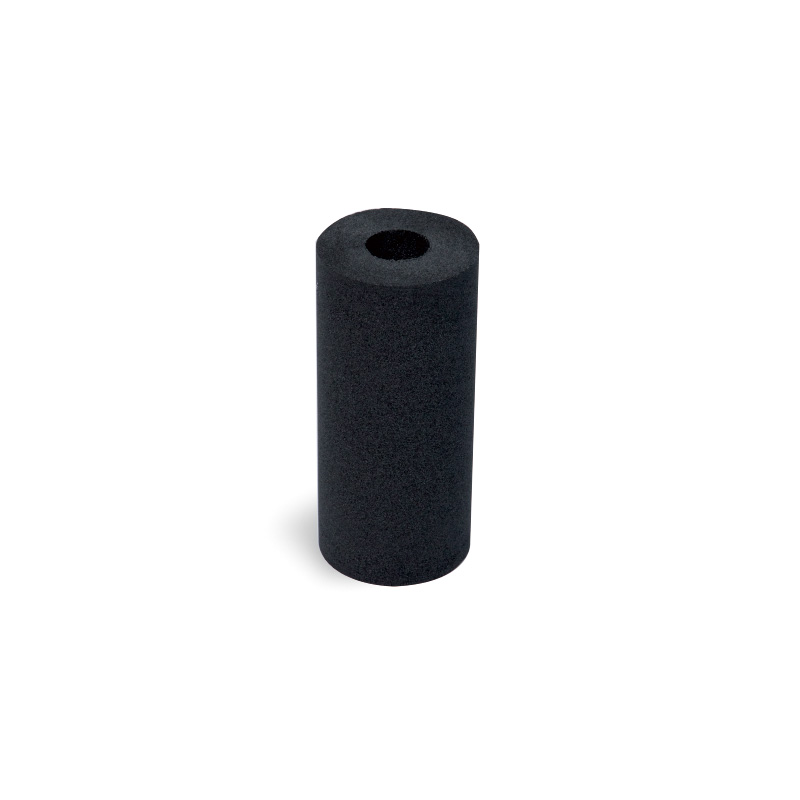
Celrith sintered activated carbon stick cartridges are designed to remove residual chlorine, taste and odour, colour, volatile organic compounds (VOCs) and certain heavy metals from drinking water. The Ф60×130 mm cartridge combines high-iodine coconut shell carbon with food-grade ion exchange resin in a porous sintered block, and is intended for domestic and commercial water purifiers, refrigerators, coffee machines and similar point-of-use systems. It reduces the contaminant load on downstream membranes and appliances while improving water taste and safety.
Municipal water often carries residual chlorine from disinfection, which reacts with organic matter to form taste- and odour-causing compounds. It can also contain trace levels of heavy metals such as lead and mercury, as well as fine particulate matter and colour bodies. In appliances, these contaminants are more than an aesthetic issue: chlorine accelerates the degradation of rubber seals and plastic components, while scale-forming minerals reduce heat-transfer efficiency and clog narrow passages. The result is shorter equipment life, higher energy consumption and more frequent maintenance.
For drinking water, the presence of chlorine and its by-products is a persistent concern. Many households and food-service operators therefore rely on carbon block filtration to polish water before it reaches the tap or the appliance. A well-designed carbon block must balance adsorption capacity, flow rate and structural integrity so that it removes contaminants without shedding fines or restricting flow.
Downstream of a carbon filter, reverse osmosis (RO) membranes are particularly sensitive to chlorine, which can oxidise the polyamide layer and cause irreversible loss of rejection. Sediment and organic fouling increase pressure drop and shorten cleaning intervals. In coffee machines and ice makers, scale and biofilm reduce performance and can affect taste. By intercepting chlorine, organics and some heavy metals, a carbon block acts as a sacrificial barrier that protects these components.
At the same time, the filter itself must not become a source of contamination. A poorly bound carbon block may release fine carbon particles (“black water”) that foul downstream filters or appear in the finished water. The sintering process used in Celrith cartridges fuses carbon particles into a rigid structure with a uniform pore network, which helps retain fines while maintaining a high initial flow rate.
Celrith sintered carbon stick cartridges are made from 100% premium coconut shell activated carbon with a high iodine number, selected for its adsorption capacity and purity. Food-grade ion exchange resin is incorporated into the matrix to soften water and help reduce heavy metal ions. The mixture is formed into a porous block through a sintering process that creates a uniform microporous structure without the use of binders that could leach into water.
This construction delivers several practical benefits. The rigid block resists channeling and bypass, so water is forced through the carbon matrix rather than finding paths of least resistance. The ion exchange resin contributes to scale reduction and heavy metal removal. The sintering process also minimises carbon fines, so the filtered water stays clear. Cartridges are available in a range of standard sizes and can be customised for length, diameter and end-cap configuration to fit specific housings.
The Ф60×130 mm size is a common form factor for inline and drop-in filters. Larger diameters such as Ф62×240 mm and smaller sizes such as Ф37.5×75 mm and Ф32×106 mm are also available. For OEM projects, Celrith can produce custom lengths and diameters, adjust the carbon-to-resin ratio, and add end caps or custom packaging to meet device-specific requirements.
| Item | Detail |
|---|---|
| Product name | Water purifier / refrigerator carbon block filter cartridge (CTO type) |
| Core filtration materials | High-iodine coconut shell activated carbon and food-grade ion exchange resin |
| Core performance | Softens water and helps prevent scaling; adsorbs residual chlorine (bleaching powder); removes off-colour and odour; intercepts harmful heavy metals such as lead and mercury |
| Accuracy and service life | Uniform micropore structure, high initial flow, high filtration accuracy and no carbon fines; large adsorption capacity for long service life |
| Standard size references (outer diameter × length, mm) | Ф60×130 / Ф62×240 / Ф37.5×75 / Ф38×57 / Ф40×195 / Ф51×127 / Ф32×126 / Ф32×106 |
| Main applications | Domestic RO purifiers (pre- or post-carbon), direct drinking water dispensers, side-by-side refrigerators with built-in water filters, commercial coffee machines |
| Customisation | Full OEM/ODM support: custom length, diameter and inner/outer diameter ratio; tooling to suit device; end-cap welding |
| Quality certification | 20,000 m² production base certified to ISO 9001 and IATF 16949; filter media meet strict drinking water safety standards; CNAS-accredited laboratory for quality control |
Celrith carbon stick cartridges serve several user groups. Appliance manufacturers integrate them as original equipment in RO systems, refrigerators and coffee machines. Water treatment OEMs and distributors specify them for replacement cartridges in residential and light commercial systems. Food-service operators use them to improve water quality for beverage preparation. In each case, the choice of size and carbon grade is matched to the device's flow rate, pressure and contaminant challenge.
For example, a side-by-side refrigerator typically requires a compact cartridge with a narrow diameter and specific end fittings, while a commercial coffee machine may need a higher-flow cartridge with a larger diameter. Celrith's standard size range covers many common applications, and custom tooling allows exact fit where space is constrained.
Celrith products are manufactured in a 50,000 m² plant in Zhongshan, Guangdong, China, which includes 20,000 m² of cleanroom space across six workshops. The company holds ISO 9001, ISO 14001 and ISO 45001 certifications, and in 2024 obtained IATF 16949 for automotive quality management. Products comply with REACH and RoHS environmental regulations, and compliance documents are available on request.
Quality control follows an IQC, IPQC and OQC process, and the CNAS-accredited laboratory provides test reports for filtration efficiency, dust holding capacity and flow resistance. With over 20 years of experience in filtration R&D and manufacturing, Celrith has developed more than 1,000 filtration solutions and exports to Europe, the United States, Japan and South Korea. Multiple automated production lines support monthly output in the millions of pieces, and OEM/ODM services cover size, structure, media grade, end-cap material, logo and packaging.
To receive a tailored quotation or to discuss a custom cartridge, please provide the following details: the device or vehicle model, the required size or a drawing, the airflow or water flow rate, the operating conditions (pressure, temperature, water quality), and the estimated quantity. With this information, Celrith can recommend the most suitable carbon grade and configuration. Contact our team via the contact page to start the conversation.
It removes residual chlorine, taste and odour, colour, volatile organic compounds (VOCs) and certain heavy metals such as lead and mercury. The built-in ion exchange resin also helps soften water and reduce scale. Typical filtration accuracy is 5 micrometres.
By intercepting chlorine and organic matter, the cartridge reduces the oxidising load on reverse osmosis membranes and rubber components. It also captures fine particles that could foul narrow passages in coffee machines and ice makers. The result is more stable performance and longer service intervals for the equipment.
Yes. Celrith offers full OEM/ODM customisation, including outer diameter, length, inner diameter ratio, end-cap welding and packaging. Standard sizes range from Ф32×106 mm to Ф62×240 mm, and custom tooling is available for specific housings.
Replacement depends on water quality and flow rate, but a typical service life is 6 to 12 months. For commercial or high-demand applications, more frequent changes may be needed. Monitoring pressure drop and taste can help determine the right interval.
For standard sizes, the MOQ is typically 1,000 to 2,000 pieces; custom sizes start at 5,000 pieces. Standard items ship within 7 to 15 days, while OEM orders generally take 25 to 35 days for production. Long-term customers can arrange scheduled deliveries.
Yes, samples are available for evaluation. Standard sizes can be provided free of charge, with the customer covering international shipping. Custom samples may incur a development fee, which is refundable against a bulk order.
Celrith holds ISO 9001, ISO 14001 and ISO 45001 certifications, and the plant is IATF 16949 certified. The CNAS-accredited laboratory can issue test reports for filtration efficiency, dust holding capacity and flow resistance. Compliance documents for REACH and RoHS are also available.
Quality control follows an IQC, IPQC and OQC process, with key operations performed in cleanrooms. Each batch is tested for flow rate, pressure drop, TOC, particle retention and extractables before release. This helps maintain consistent performance across orders.